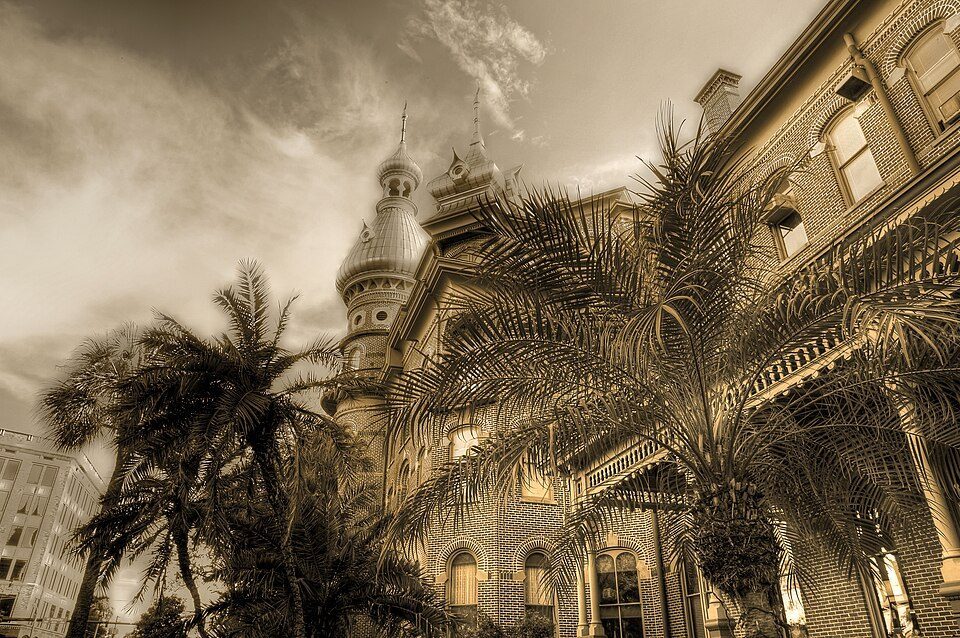
In 1891, a winter visitor arriving at Henry Plant’s Tampa Bay Hotel entered a building whose ambitions exceeded the town around it. There were electric lights, telephones in guest rooms, elevators, and furnishings gathered in Europe. The hotel’s Moorish Revival towers announced more than expensive accommodation. Here was a railroad owner constructing evidence that his destination deserved the journey. Plant had brought the railroad to Tampa in 1884; now he supplied a spectacular reason to ride it. [1](nps.gov/places/tampa-bay-hotel.htm) [2](plantmuseum.com/about/history)
Across the peninsula, Henry Flagler was practicing a related art. His Ponce de Leon Hotel had opened in St. Augustine in January 1888, and his railway purchases and improvements supported an expanding resort enterprise. The two men did not simply respond to an established tourist market. They assembled transportation, accommodation, and publicity into systems that could create one. The hotel made the destination imaginable; the railway made it repeatable. [3](en.wikipedia.org/wiki/Henry_Flagler)
Their importance is therefore larger than a contest between east and west. Together, their enterprises helped establish a durable Florida arrangement: private investment chose a corridor, towns organized around access to it, and workers supplied the physical and social machinery behind the advertised escape. Modern Florida was not drawn on an empty sheet. But these two systems gave extraordinary weight to particular places, turning decisions about tracks and terminals into decisions about whose land, labor, and future would become valuable.
Flagler’s chain of destinations
St. Augustine supplied Flagler with a place already rich in historical associations. Rather than inventing the city, he intensified its appeal through grand hotels and improved transportation. He acquired short railroads and converted narrow-gauge track to standard gauge, allowing heavier loads and more traffic. The achievement was organizational as well as architectural: a luxurious building was less useful if reaching it remained awkward, slow, or uncertain. His railroad and hotels solved complementary parts of the same business problem. [3](en.wikipedia.org/wiki/Henry_Flagler)
By 1894, the railway reached West Palm Beach, while the Royal Poinciana Hotel opened across Lake Worth in Palm Beach. That pairing matters. The familiar story follows wealthy visitors into their resort, but the system also required a service town. The distinction between the place where leisure was consumed and the place that supported it was built into the enterprise. Palm Beach’s glamour and West Palm Beach’s practical functions belonged to one economic arrangement, not two unrelated urban histories. [3](en.wikipedia.org/wiki/Henry_Flagler)
The southern terminus did not remain fixed. After the freezes of 1894 and 1895, landowners farther south, including Julia Tuttle and William Brickell, offered inducements for further expansion. The railway reached Miami in 1896, the year of the city’s incorporation; Flagler’s Royal Palm Hotel followed in 1897. Miami’s emergence was thus neither a miracle nor the solitary invention of a magnate. It involved landowners bargaining over access, a railroad seeking traffic, and investment in streets, utilities, and accommodation. [3](en.wikipedia.org/wiki/Henry_Flagler)
The sequence makes the essential mechanism visible. A resort could attract passengers; passengers could justify service; service could make adjoining land more attractive for settlement and investment. Each element reinforced the others. Flagler’s line was a transportation business, but it also functioned as a framework within which a succession of places could be marketed as the next plausible Florida.
Plant’s gateway faced the Gulf
Plant’s system produced a different regional emphasis. His enterprises combined railroads with steamship connections, making Tampa a gateway rather than merely a stopping place. The National Park Service dates his railway’s arrival to 1884 and describes the connection between downtown Tampa, Port Tampa, and steamship destinations including Havana. Land and water transportation belonged to the same network. The Gulf was not Florida’s back edge; it was a route into wider commercial and passenger traffic. [1](nps.gov/places/tampa-bay-hotel.htm)
This helps explain why Tampa’s growth cannot be reduced to the fortunes of one luxury hotel. Fishing gained access to markets, products moved into the city, and Ybor City’s cigar manufacturers used Plant’s trains to reach customers elsewhere in the United States. The railway served production as well as consumption. Tampa’s promise rested partly on visitors arriving with luggage, but also on goods departing in quantity. The hotel was the conspicuous face of an enterprise whose less decorative business was moving freight. [1](nps.gov/places/tampa-bay-hotel.htm)
The Tampa Bay Hotel nevertheless expressed the system’s ambitions with unusual clarity. Built between 1888 and 1891, it offered 511 rooms and a seasonal social world of formal dining and entertainment. Plant financed its construction from his own wealth. Its apparent extravagance was an argument about place: a city connected to this degree of modern convenience could claim a different standing in the national imagination. Luxury was not an accessory to the infrastructure. It helped explain and advertise the investment. [2](plantmuseum.com/about/history)
In 1898, the hotel served as headquarters for the Army’s invasion of Cuba during the Spanish-American War. A landscape promoted for winter retreat became useful to military mobilization because the underlying connections already existed. The episode exposed what resort imagery could conceal: transportation infrastructure was adaptable power. The same network that delivered holidaymakers could concentrate personnel and supplies for an overseas campaign. [1](nps.gov/places/tampa-bay-hotel.htm)
What a stop could give, or take away
Railroad maps can look inevitable once cities have grown around them. Flagler’s expansion reveals how contingent they were. New Smyrna and Titusville developed along the advancing route; Fort Pierce and West Palm Beach became successive points in its southern movement. A town connected to scheduled transport could participate more directly in distant markets and tourist circuits. A railway stop did not guarantee prosperity, but it changed the terms on which prosperity could be pursued. [4](en.wikipedia.org/wiki/Florida_East_Coast_Railway)
The east-coast story also cautions against treating every station as a city created from nothing. Existing settlements acquired new functions and new pressures. St. Augustine had a history that long preceded Flagler, just as Key West was already a substantial maritime city before his extension reached it. Rail investment reorganized relationships between places that possessed their own people, businesses, and claims. To call a magnate a founder can obscure the difference between originating a community and greatly enlarging its access to capital. [3](en.wikipedia.org/wiki/Henry_Flagler) [4](en.wikipedia.org/wiki/Florida_East_Coast_Railway)
Key West supplied the most dramatic test of how far that logic could travel. The Overseas Railroad opened to passenger service in 1912 after years of difficult construction. Flagler envisaged commercial opportunities connected with the Panama Canal and maritime trade. The extension pushed a continental transportation system across an island chain, making a claim about the future that required extraordinary engineering and labor. Its boldness should not be confused with proof that every commercial expectation would be fulfilled. [4](en.wikipedia.org/wiki/Florida_East_Coast_Railway)
The Labor Day hurricane of 1935 partially destroyed the extension, and trains never resumed the journey to Key West. Some surviving infrastructure was adapted for the Overseas Highway. Here the consequence of losing tracks was not simply that a town disappeared. A corridor changed its technology and continued to channel movement. This is a more useful model than a roll call of supposed railroad ghost towns: access could be transformative, withdrawal damaging, and the built route durable even after the original enterprise failed. [5](en.wikipedia.org/wiki/Overseas_Railroad)
The workers outside the picture
A railway panorama tends to put the locomotive in the foreground and the people who built the line somewhere beyond the frame. That is an ethical distortion as well as an incomplete history. The Florida East Coast Railway’s construction involved dangerous work, severe living conditions, and a workforce recruited through labor agencies. Accounts describe indebtedness and coercion; federal investigations and prosecutions became part of the railway’s history. The record is not adequately summarized by calling the undertaking an engineering triumph. [4](en.wikipedia.org/wiki/Florida_East_Coast_Railway)
Convict labor, overwhelmingly associated with the exploitation of Black prisoners in the region, also belongs in the account of early construction. The available summaries differ in how categorically they assign particular abuses to Flagler and how they assess the accusations against his organization. That distinction should remain visible. Evidence of harsh conditions and coercive recruiting does not license an invented conviction, while the failure of a prosecution does not make those conditions disappear. Historical caution must work in both directions. [3](en.wikipedia.org/wiki/Henry_Flagler) [4](en.wikipedia.org/wiki/Florida_East_Coast_Railway)
Nor did the economic world created by the railways distribute its rewards equally. Hotels depended on service work as surely as trains depended on track crews. Palm Beach’s resort and its associated service town make that hierarchy legible in geography. The national freedom being advertised was the freedom to travel south and be attended to. The labor that made such freedom possible was not itself interchangeable with the experience being sold. [3](en.wikipedia.org/wiki/Henry_Flagler)
The railroad resort was not outside the South’s racial order merely because it served northern visitors. For that reason, the history of modernization cannot be measured solely by arrival dates, room counts, or miles completed. Technical connection and social equality are different achievements. A network can make land more profitable and journeys more comfortable while leaving the people who clear, carry, cook, and clean with sharply restricted choices. The costs belong inside the explanation of success, not in a qualifying sentence afterward.
The map beneath the map
Neither railroad empire survived unchanged. Plant’s system became part of the Atlantic Coast Line, while the Florida East Coast Railway continued under later owners and changing business conditions. The corporate names shifted, but consolidation did not erase the locational advantages already established. Ports, commercial districts, and settlement corridors had accumulated around connections that could not simply be lifted away like lettering on a timetable. [6](en.wikipedia.org/wiki/Henry_B._Plant) [4](en.wikipedia.org/wiki/Florida_East_Coast_Railway)
On the Atlantic side, contemporary passenger service makes that inheritance unusually visible. Brightline uses the Florida East Coast corridor between Cocoa and Miami before taking its route toward Orlando. This is not a claim that a modern train reproduces Flagler’s business model or serves precisely the same public. It is evidence that a nineteenth-century alignment can remain a powerful fact in twenty-first-century decisions about where movement is practicable. Old infrastructure continues to shape the menu of new possibilities. [4](en.wikipedia.org/wiki/Florida_East_Coast_Railway)
Plant’s hotel offers a quieter form of continuity. The former resort is now associated with the University of Tampa and the Henry B. Plant Museum. Flagler’s Ponce de Leon likewise survives as part of Flagler College. Buildings devised to concentrate seasonal wealth became institutions with other purposes. Their survival is not the survival of the original economy intact; it is proof that expensive acts of place-making can outlast the markets and social rituals that justified them. [1](nps.gov/places/tampa-bay-hotel.htm) [3](en.wikipedia.org/wiki/Henry_Flagler)
The question these railroads leave Florida is not whether development should occur. It is who gets to draw its first persuasive line, and who bears the consequences afterward. Flagler and Plant understood that access could manufacture value. Their legacy asks the present to understand something equally important: the shape of growth is a choice before it becomes an inheritance. The rails helped make modern Florida possible, but possibility was never distributed evenly.
Sources and photograph
Photograph: Tampa Bay Hotel by Tfloyd via Wikimedia Commons, CC BY-SA 3.0: commons.wikimedia.org/wiki/File:Tampa_Bay_Hotel.jpg. This essay draws on the sources listed below. Contested accounts are identified as such in the text.
Questions readers ask
- What did Henry Flagler do for Florida?
- He developed resort hotels and expanded the Florida East Coast Railway south to Miami and Key West. His hotels and transportation investments helped reorganize settlement and tourism along the Atlantic coast; see the Flagler and FEC histories below.
- What did Henry Plant do for Tampa?
- Plant brought the railroad to Tampa in 1884 and connected rail service with steamships. The National Park Service credits those connections with expanding tourism and markets for industries including fishing and cigars.
- When did the railroad reach Miami?
- The Florida East Coast Railway reached Miami in 1896, also the year the city incorporated. Flagler’s Royal Palm Hotel opened the following year, according to the Flagler history.
- Why did the train to Key West stop running?
- The 1935 Labor Day hurricane partially destroyed the Overseas Railroad, and service was not restored. Some surviving infrastructure was adapted for the Overseas Highway; see the Overseas Railroad source.
Sources
- 01National Park Service: Tampa Bay Hotel
- 02Henry B. Plant Museum: hotel history
- 03Henry Flagler: hotels, railway expansion, and labor controversies
- 04Florida East Coast Railway: construction, labor, and later operations
- 05Overseas Railroad: construction and hurricane destruction
- 06Henry B. Plant and the Plant System
- 07The 1920s Florida land boom: speculation and collapse
- 08Wikimedia Commons: photograph metadata and license