On January 10, 1926, the Prinz Valdemar sank at the mouth of the turning basin in Miami harbor. The sailing ship was supposed to become a floating hotel, an improvised answer to a city straining to accommodate its own popularity. Instead, it obstructed access to the port. Few episodes could have condensed the Florida land boom more neatly: even a vessel brought to house the crowd became an obstacle to building the city the crowd expected. [1](en.wikipedia.org/wiki/Prinz_Valdemar)
The obstruction mattered because another route was already constrained. In October 1925, the major railroads serving Florida had imposed an embargo on nonessential freight amid congestion. Building supplies had become difficult to move before the ship capsized. Miami’s advertised abundance depended on narrow physical channels, and those channels were failing to carry the volume of expectation moving through the market. The spectacle of limitless growth had encountered the finite dimensions of transportation. [2](en.wikipedia.org/wiki/1920s_Florida_land_boom)
It is tempting to tell what followed as a morality play completed by a hurricane: greed, warning, catastrophe. That is too simple. The boom built actual streets, hotels, and neighborhoods, and some of its planning remains compelling. Its failure arose not because every improvement was imaginary, but because the market increasingly priced a future resale rather than a place’s capacity to support life. When that distinction became impossible to ignore, Florida’s depression began before the national Depression arrived.
A small payment on an enormous tomorrow
The University of South Florida’s account describes an audience broader than the wealthy winter visitor of an earlier era. Automobiles, greater mobility, and access to credit brought middle-class families into the story. Homes and land became attractions in their own right. Florida was no longer only somewhere to stay for a season. It could be purchased as an anticipated life, or purchased more briefly as an anticipated profit. [3](fcit.usf.edu/florida/lessons/ld_boom/ld_boom1.htm)
The binder made the second possibility especially seductive. A buyer paid a nonrefundable deposit and faced a short period in which to complete the transaction; the university account describes the balance as due in thirty days. If the contract could be resold first, the buyer could profit without supplying the full purchase price. The arrangement rewarded speed and an expanding queue of successors. Money insufficient to buy the property might be sufficient to speculate on its next price. [3](fcit.usf.edu/florida/lessons/ld_boom/ld_boom1.htm)
The familiar binder boys were therefore more than colorful characters in a hot-weather anecdote. They represented the transaction as a local occupation and the contract as a circulating opportunity. Sales agents showed land and collected deposits while buyers contemplated another sale. The essential question shifted from whether a parcel was suitable for a house or business to whether someone else could soon be persuaded to pay more. This was not identical to ordinary settlement, even when both activities occupied the same office. [3](fcit.usf.edu/florida/lessons/ld_boom/ld_boom1.htm)
A rising market could conceal that shift. A road under construction was an improvement, but also evidence for a sales pitch; a new hotel was useful accommodation, but also a reason to believe surrounding lots would appreciate. The trouble came when expected appreciation justified a price that needed still more appreciation to make sense. The boom’s vulnerability lay in this dependence on continuation, not simply in dishonest salesmanship or an allegedly gullible public. Infrastructure could be real while the chain of financial assumptions around it remained fragile.
Cities as the sales argument
Coral Gables gave the promise unusually coherent form. Developed by George Merrick and incorporated on April 29, 1925, it drew on City Beautiful planning and a Mediterranean architectural vocabulary. Its planned districts and controlled appearance offered an alternative to the isolated speculative lot: buyers were invited into a complete urban composition. The Biltmore Hotel opened in 1926. Here, building a convincing city and selling a convincing investment were closely related undertakings. [4](en.wikipedia.org/wiki/Coral_Gables,_Florida)
That achievement should neither be dismissed as scenery nor mistaken for a guarantee of sound finance. A strong plan could improve the eventual place while also intensifying confidence in its immediate sale price. The boulevards, landmarks, and architectural consistency made the future seem visible in advance. A development that could be pictured as a finished community possessed a powerful advantage over raw acreage. Its beauty was real, but beauty did not determine how quickly buyers could pay or how long credit would remain available.
Miami Beach supplied another version of deliberate place-making. Carl Fisher’s development and publicity helped turn the beach into a nationally recognized proposition. Transportation access, improvements, and relentless promotion worked together: the landscape had to be reachable, but the public also had to learn how to desire it. The boom did not merely follow demand south. Promoters helped organize that demand around a particular image of warm-weather life. [5](en.wikipedia.org/wiki/Carl_G._Fisher)
The invitation was selective. The boom’s developments included racially restrictive deeds and forms of exclusion that shaped cities long after the sales campaigns ended. To advertise a community as exclusive was to turn a social barrier into a marketable amenity. Any architectural appreciation that ignores this machinery misses part of what buyers were being sold. The planned future included decisions about who could own property and belong, as well as decisions about roofs, roads, and views. [2](en.wikipedia.org/wiki/1920s_Florida_land_boom)
Mizner’s city, Davis’s islands
In Boca Raton, Addison Mizner enlarged an architectural reputation into a development proposition. His Mediterranean Revival work had helped shape elite taste in Palm Beach. The larger venture sought to translate that authority into a whole resort community. Yet the cash available to the development corporation did not match the scope of its advertised commitments. An architect’s ability to make buildings persuasive was not the same thing as a corporation’s ability to finance a city. [6](en.wikipedia.org/wiki/Addison_Mizner)
The Cloister Inn and other improvements were tangible achievements, but they did not rescue the enterprise from financial trouble. The corporation’s assets passed to Clarence Geist in 1927. Mizner’s story is revealing precisely because it does not divide cleanly into genuine construction on one side and empty promotion on the other. Both existed together. Buyers could encounter a remarkable building and still misunderstand what that building proved about the rest of the promised development. [6](en.wikipedia.org/wiki/Addison_Mizner)
On the Gulf side, D. P. Davis made the physical ground itself part of the proposition. Davis Islands, at the mouth of Tampa’s Hillsborough River, expanded small natural islands with material dredged from Tampa Bay. The proposed resort community included hotels, recreation, and an airport. The project extended the boom’s logic beyond assigning a new price to existing land: a developer could manufacture additional land and then sell a complete account of the life it would support. [7](en.wikipedia.org/wiki/Davis_Islands_(Tampa))
Development stalled as the boom subsided, and Davis disappeared at sea in October 1926. Yet the islands endured, as did Mediterranean-style buildings including the Palace of Florence and Mirasol. The discrepancy between the interrupted project and the surviving neighborhood is important. A failed financial timetable did not make the resulting place unreal. It did, however, leave later residents to inhabit choices about shorelines and building sites that had been made under the pressure of an extraordinary sales campaign. [7](en.wikipedia.org/wiki/Davis_Islands_(Tampa))
The collapse before the storm
By 1925, criticism was already reaching prospective investors. Forbes questioned prices dependent on finding another customer, and speculators encountered increasing difficulty locating buyers. Congestion compounded the problem: supplies ordered into a booming market overwhelmed rail capacity, prompting the freight embargo. These were not consequences of the September 1926 hurricane. They were signs that the boom’s financial and logistical foundations were under strain well before that disaster. [2](en.wikipedia.org/wiki/1920s_Florida_land_boom)
The Prinz Valdemar sharpened an existing crisis rather than creating speculation’s weaknesses by itself. Its position at the harbor’s turning basin made the incident consequential while the rail restrictions remained in force. But a blocked channel cannot explain why a binder purchaser needed another purchaser, why advertised improvements exceeded available cash, or why an investor had paid a particular price. The ship belongs in the explanation as a damaging interruption and a public symbol, not as the sole cause of the bust. [1](en.wikipedia.org/wiki/Prinz_Valdemar) [2](en.wikipedia.org/wiki/1920s_Florida_land_boom)
The distinction matters because a single-cause story supplies a reassuring escape. If the ship alone ruined the market, then the market’s assumptions need not be examined. If the hurricane alone ended prosperity, the boom could be remembered as sound business defeated by nature. The chronology does not permit either comfort. Transport restrictions were lifted in May 1926, but the removal of one constraint did not automatically restore buyers, confidence, or the earlier momentum of prices. [2](en.wikipedia.org/wiki/1920s_Florida_land_boom)
Public finances extended the consequences beyond investors. Local governments had borrowed for improvements during the expansion; after the collapse, revenues did not support the obligations as expected. Banks also came under pressure from withdrawals and loan defaults. Florida entered the national crisis after years of its own deterioration, with debt and weakened institutions already limiting its room to maneuver. The 1929 crash did not begin this story. It arrived in a state that had already spent part of its expected future. [2](en.wikipedia.org/wiki/1920s_Florida_land_boom)
Two hurricanes, unequal losses
The September 1926 Miami hurricane brought destructive winds, flooding, and enormous damage to the urban landscape. It also struck the remaining confidence on which recovery depended. Construction and property could be destroyed in hours, while the ability to attract replacement investment could be damaged for much longer. The storm did not have to originate the downturn to deepen it decisively. Physical catastrophe and an already failing market reinforced one another. [8](en.wikipedia.org/wiki/1926_Miami_hurricane) [2](en.wikipedia.org/wiki/1920s_Florida_land_boom)
Two years later, the Okeechobee hurricane exposed another Florida geography. In September 1928, wind-driven water escaped the southern side of Lake Okeechobee and devastated surrounding communities. At least 2,500 people drowned in the lake region, according to the historical summary. These deaths cannot responsibly be treated as a final punctuation mark in a tale about speculative fortunes. The people most exposed included agricultural laborers whose relationship to the land was work, not a wager on resale. [9](en.wikipedia.org/wiki/1928_Okeechobee_hurricane)
Many victims were Black farmworkers. Racial discrimination continued into recovery and burial: white victims received treatment and commemoration denied to many Black victims, whose bodies were placed in mass graves or burned. The disaster revealed a hierarchy that the language of universal opportunity had concealed. Risk was not evenly shared, and neither was the public obligation to remember the dead. The same state could advertise land as a future for outsiders while failing to protect people already laboring on it. [9](en.wikipedia.org/wiki/1928_Okeechobee_hurricane)
To put the two storms together is therefore not to make them interchangeable. Miami’s hurricane struck the emblematic city of the boom; Okeechobee’s catastrophe exposed the vulnerability of an agricultural landscape and its workers. Both belong in the account, but for more than their effect on prices. A history concerned only with investment losses would repeat the boom’s original mistake: valuing land chiefly through the expectations of those in a position to buy it.
The inheritance beneath the roof tiles
The boom’s architectural legacy is easy to admire because it is still available to the eye. Coral Gables retains the force of a planned composition; Boca Raton carries the imprint of Mizner’s ambitions; Davis Islands preserves buildings from its interrupted development. These survivals are not evidence that the speculation was harmless. They show how buildings and urban patterns can outlast the financial arrangements that first brought them into being. [4](en.wikipedia.org/wiki/Coral_Gables,_Florida) [6](en.wikipedia.org/wiki/Addison_Mizner) [7](en.wikipedia.org/wiki/Davis_Islands_(Tampa))
The less visible inheritance includes debt, exclusion, and altered land. A dredged island does not revert to its earlier shoreline when a sales campaign ends. A city’s beauty does not cancel the restrictions once used to define its market. Florida inherited both the spaces worth preserving and the obligations their creation left behind. That double inheritance is more demanding than the familiar choice between celebrating the builders and ridiculing the speculators.
The useful comparison with Florida today is a question rather than an unsupported claim that every later cycle repeats the same script. What, exactly, is a buyer purchasing: a usable place, a financed improvement, or confidence in the arrival of someone willing to pay more? The 1920s offered all three, sometimes in the same transaction. Its enduring warning is not that Florida’s appeal is false. It is that an appealing place and a sustainable price are not the same thing, and the difference eventually has to be paid.
Sources and photograph
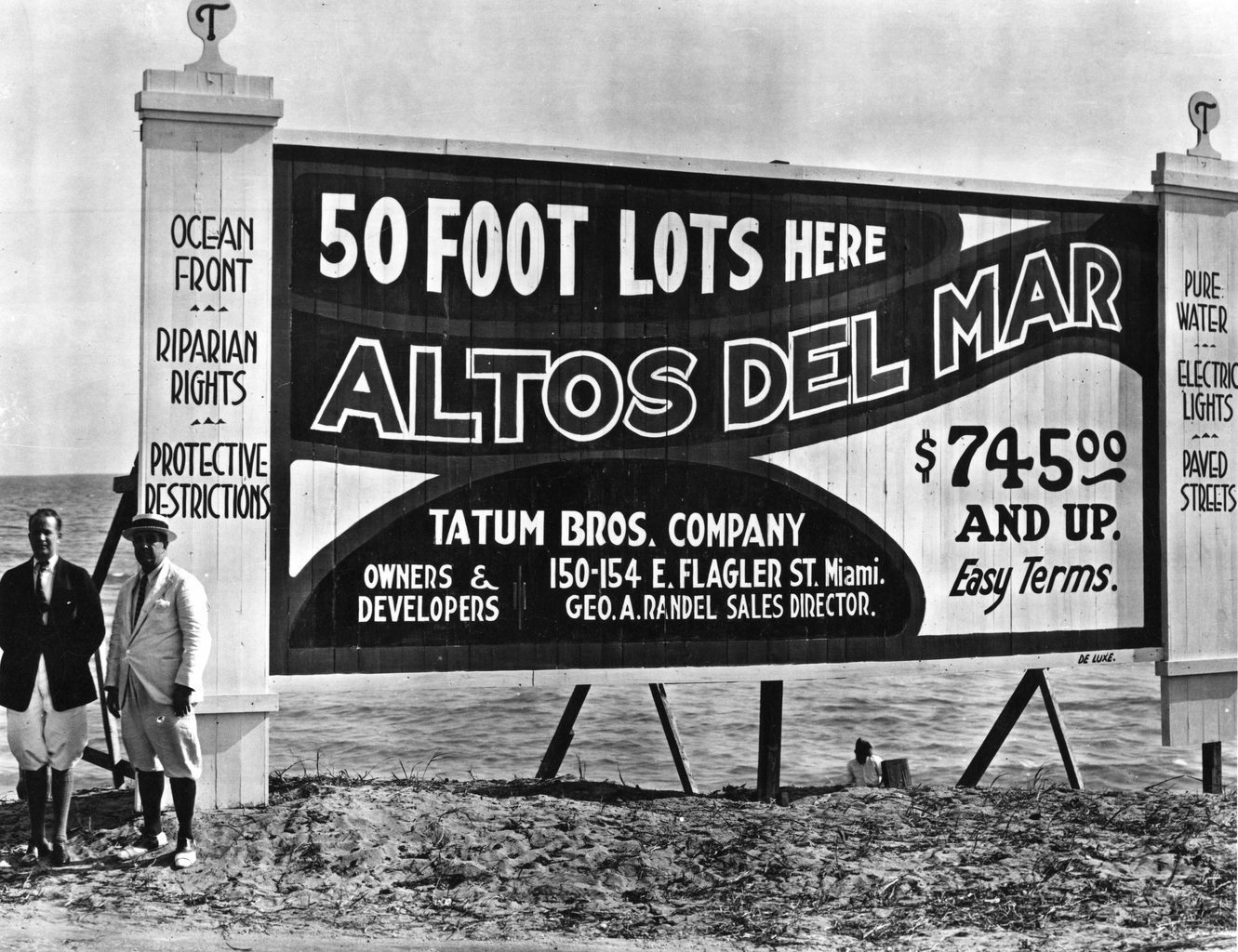
Photograph: Billboard for the Sale of Subdivision Real Estate Lots (World Digital Library 4030) via Wikimedia Commons, Public domain: commons.wikimedia.org/wiki/File:Billboard_for_the_Sale_of_Subdivision_Real_Estate_Lots_WDL4030.png. This essay draws on the sources listed below. Contested accounts are identified as such in the text.
Questions readers ask
- What caused the Florida land boom of the 1920s?
- Growing mobility, accessible credit, promotion, and expectations of rising land prices attracted buyers. The University of South Florida describes how binder contracts allowed speculation without paying the full purchase price immediately.
- What were binder boys in the Florida land boom?
- The term refers to sales agents associated with collecting deposits and arranging rapid land transactions. The USF account explains that a binder was nonrefundable and the balance could be due within thirty days, encouraging resale before payment.
- Did the Prinz Valdemar cause the Florida land bust?
- Its January 1926 sinking obstructed Miami harbor during an existing rail-freight embargo. It aggravated the crisis, but the land-boom history documents weakening confidence and difficulty finding buyers before the obstruction.
- Did Florida’s land bust happen before the Great Depression?
- Yes. The boom failed in 1926, years before the 1929 national financial crash, and subsequent hurricanes deepened the damage; see the land-boom and hurricane histories.
- What architecture survives from the Florida land boom?
- Coral Gables, Mizner-associated Boca Raton, and Mediterranean-style buildings on Davis Islands preserve important parts of the era’s built landscape. The corresponding place and architect histories below distinguish those surviving achievements from the developers’ uncompleted plans.
Sources
- 01The 1920s Florida land boom: speculation and collapse
- 02University of South Florida: Florida’s Land Boom
- 03Prinz Valdemar and the obstruction of Miami harbor
- 04The 1926 Miami hurricane
- 05The 1928 Okeechobee hurricane and its unequal aftermath
- 06Coral Gables: planning and development
- 07Carl G. Fisher and Miami Beach
- 08Addison Mizner and the Boca Raton development
- 09Davis Islands: dredging, development, and architectural legacy
- 10University of South Florida: Rodney Kite-Powell’s study of D. P. Davis
- 11Wikimedia Commons: contextual Tampa Bay Hotel photograph