History
The History of St. Augustine
St. Augustine history: founded September 8, 1565 by Pedro Menéndez de Avilés, and continuously inhabited under Spanish, British and American rule since.
3 min read6 sources
Read
Founded 1565. America's oldest continuously inhabited European-established city — and still the most layered.
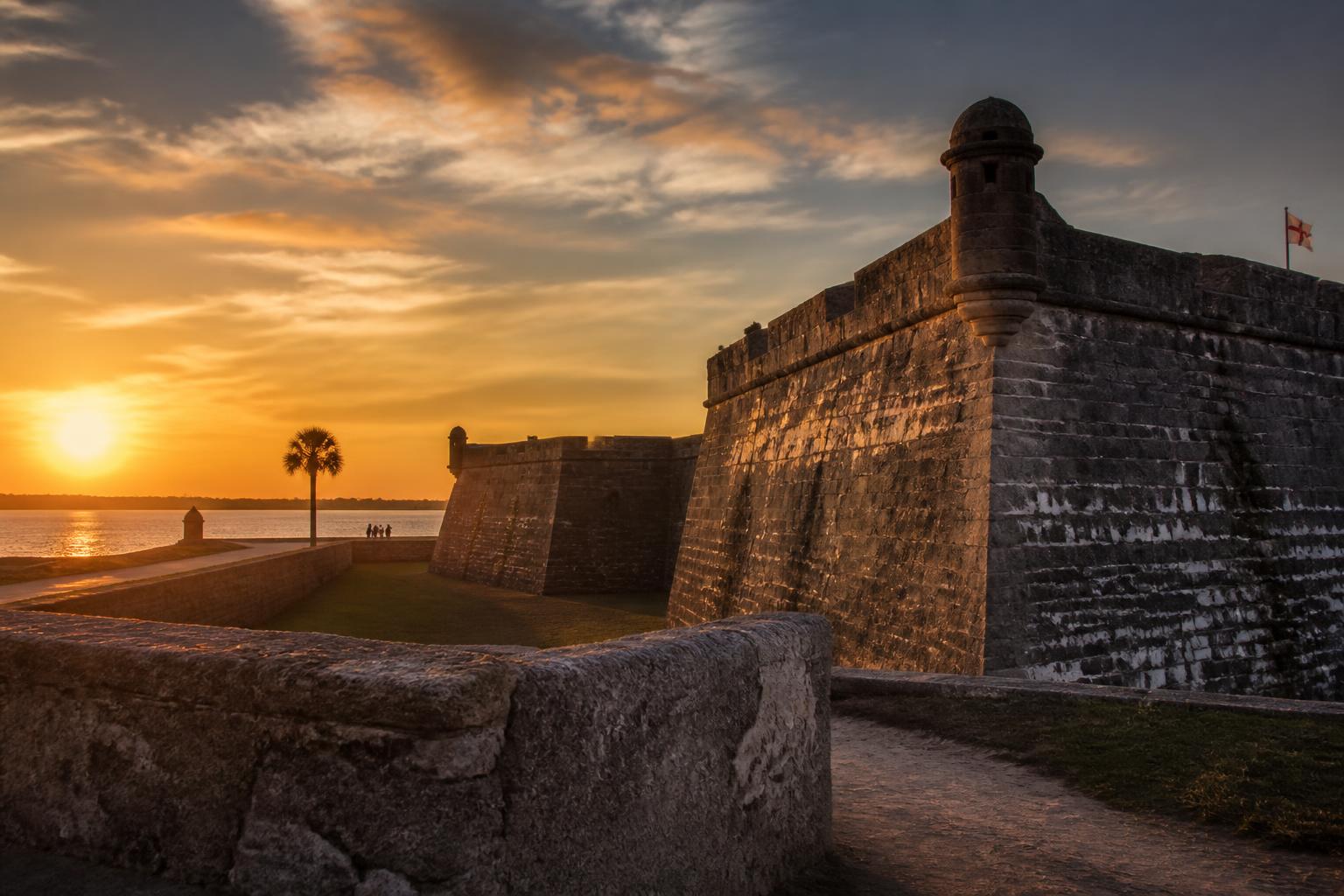
1672 coquina fortress — the oldest masonry fort in the continental United States, never taken by force
Henry Flagler's 1888 Hotel Ponce de Leon — Spanish Renaissance Revival, Tiffany stained glass, electric from day one
Pedestrian spine of the colonial quarter — coquina walls, wooden balconies, four centuries of foot traffic
1866 Black neighborhood and Civil Rights movement landmark — where Dr. King was arrested in 1964
The same six attributes are recorded for every city in the Florida Slice archive.
St. Augustine holds intact fabric from Spanish colonial, British colonial, Second Spanish Period, Territorial, Gilded Age, Jim Crow, Civil Rights, and modern periods inside roughly fifteen walkable blocks.
America's oldest continuously inhabited European-established city — and still the most layered. The sections below break the feature into its parts — the four-century history, the coquina-and-Gilded-Age architecture, the two historic districts, and where to eat. Each one is sourced.
St. Augustine history: founded September 8, 1565 by Pedro Menéndez de Avilés, and continuously inhabited under Spanish, British and American rule since.
3 min read6 sources
Read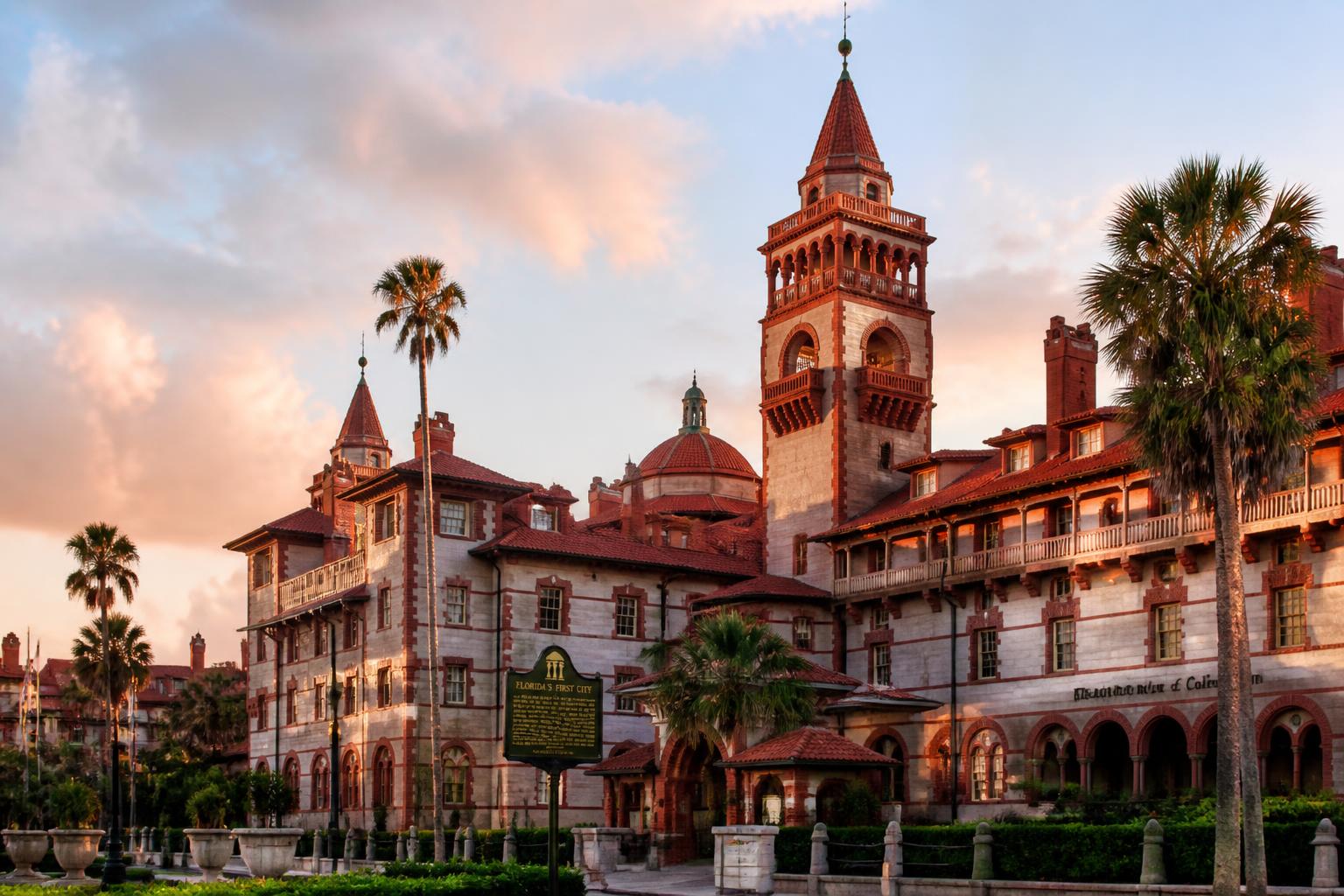
St. Augustine architecture spans two eras: coquina Spanish military building begun in 1672 and Henry Flagler's 1880s Spanish Renaissance Revival hotels.
3 min read7 sources
Read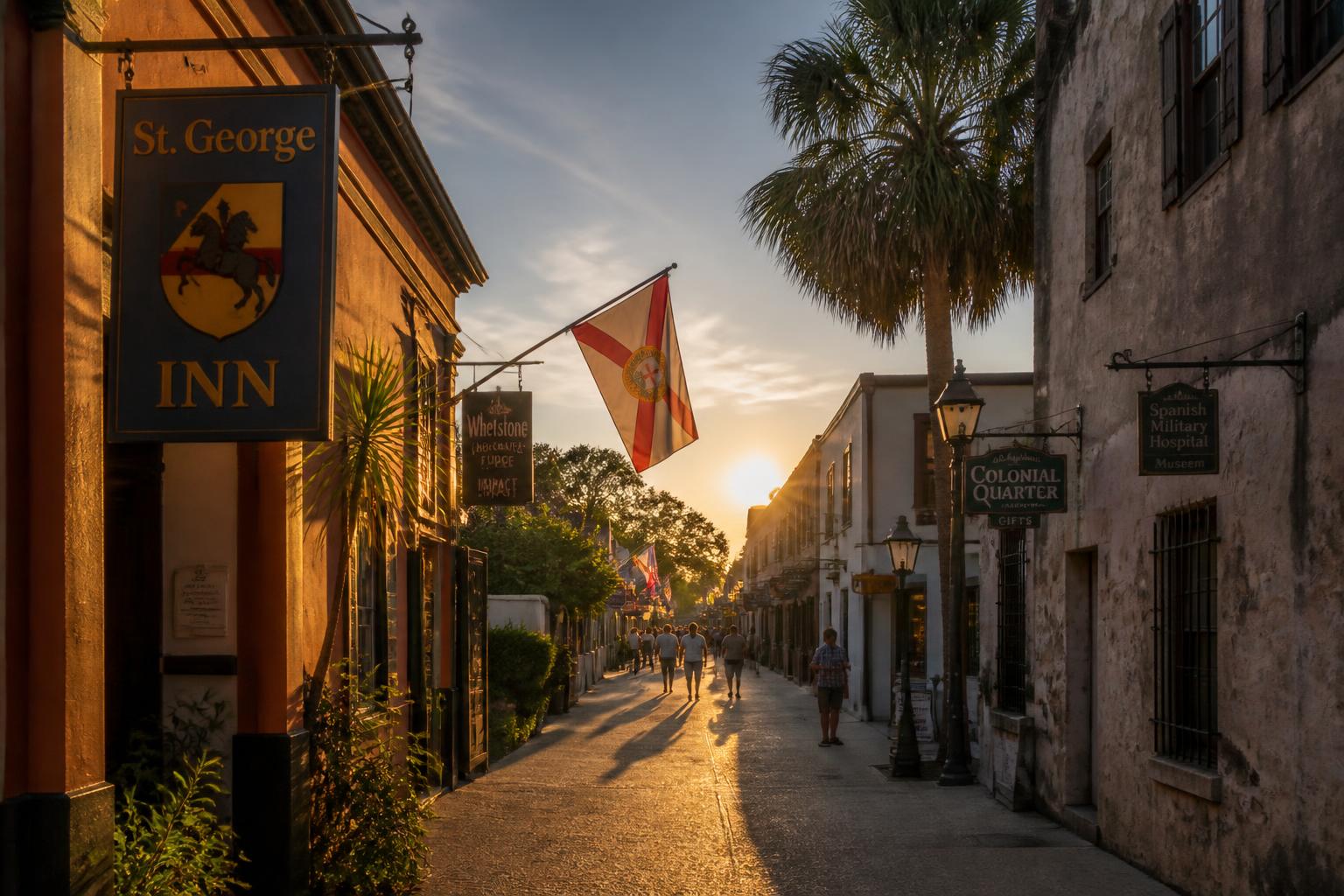
St. Augustine's two historic districts: the 16th-century colonial quarter on St. George Street and Lincolnville, founded by freedmen in 1866, six blocks apart.
3 min read5 sources
ReadSt. Augustine's cooking is not generic Florida coastal cooking, and the reason is a specific migration. In 1777 the surviving colonists of Andrew Turnbull's failed indigo plantation at New Smyrna — Minorcans, along with Greeks and Italians recruited from the Mediterranean — walked north and resettled here, where their descendants have remained ever since. Their kitchen is still the local kitchen: pilau, clam chowder built on tomato rather than cream, fromajardis pastries at Easter, and above all the datil, a small, intensely hot, faintly sweet pepper grown here in a way it is grown almost nowhere else in the country.
That is the through-line worth eating your way along. The datil turns up in hot sauce on nearly every table in town, in chowder, in barbecue glaze, and in the house condiments restaurants bottle and sell at the register. It is the single ingredient that tells you where you are.
Spanish · Cuban · Since 1905
The St. Augustine outpost of Florida's oldest restaurant, begun in Ybor City in 1905 for the Cuban and Spanish cigar-factory workforce. Order the 1905 salad tossed tableside and the black bean soup and you have the century-old core of the menu. 98 St George St.
Modern Southern · Farm-to-table
Where the Minorcan inheritance shows up in contemporary form: datil heat used as seasoning rather than novelty, local produce, fried green tomatoes, shrimp and grits on stone-ground corn. Small, fills early, the most reliable single recommendation in the old city. 72 Spanish St.
Cocktails · Distillery
The building is the point. The 1927 ice plant supplied the city's fishing and produce trade before refrigeration made it obsolete; the restoration kept the brick, the steel, and the machinery, and put a distillery on one side and a bar on the other. 110 Riberia St.
Breakfast in the colonial quarter, lunch at the Columbia if you want the historic menu or the Floridian if you want the local one, an afternoon across the Bridge of Lions at Anastasia State Park to reset, and cocktails on Riberia Street in the evening. That sequence covers the Spanish, the Minorcan, and the industrial layers of the city's food history in a single day — and it keeps you out of the trolley crowds at the two hours they are worst.
Castillo de San Marcos National Monument
National Park Service
Castillo de San Marcos — History & Culture
National Park Service
ACCORD Freedom Trail and Civil Rights Museum
ACCORD Freedom Trail
Flagler College — the former Hotel Ponce de Leon
Flagler College
Lightner Museum — the former Hotel Alcazar
Lightner Museum
St. Augustine Historical Society — Oldest House (González-Alvarez House)
St. Augustine Historical Society
National Register of Historic Places — St. Augustine Town Plan Historic District (NRIS #70000847)
National Park Service · 1970-04-15
Columbia Restaurant — St. Augustine
Columbia Restaurant Group · 1905
The Floridian
The Floridian, St. Augustine
Ice Plant Bar and St. Augustine Distillery
Ice Plant Bar · 1927
Anastasia State Park
Florida State Parks
How we cite and verify is documented in our editorial standards.
Walk into the old city through the coquina city gate on St. George Street and you are, physically, walking into 1565. Not a re-creation. Not a themed reconstruction. The stone under your feet is the actual stone. The lot lines are the original Spanish lot lines. The coquina — that porous limestone made of compressed shells that quarried out of Anastasia Island — is the material Pedro Menéndez's colonists first cut for the presidio and the Castillo. Four hundred and sixty years later, the same coquina is holding up the same walls.
This is what makes St. Augustine, correctly understood, the anomaly of American cities. Most old American towns lost their pre-industrial fabric to fire, flood, or the same generation of 1960s urban renewal that gutted every downtown from Buffalo to Birmingham. St. Augustine did not. The National Park Service holds the fort. The state has held large parts of the colonial quarter since the 1960s. The private preservation record, block by block, is unusually intact. The result is one of the very few American cities where you can read Spanish colonial, British colonial, Second Spanish Period, Territorial, Gilded Age, Jim Crow, Civil Rights, and modern all in the same fifteen blocks.
Florida has three cities with genuine pre-1800 fabric. St. Augustine (1565) is the oldest continuously occupied European settlement in the continental United States. Fernandina Beach, on Amelia Island, is the only U.S. town to have flown eight flags, with an intact 50-block Victorian district on top of its colonial layers. Pensacola, over on the panhandle, holds the Seville and Palafox districts and the ruins of Fort Barrancas.
The three are the essential Old Florida circuit — each preserving a different chapter of the state's pre-statehood story.
St. Augustine was founded on September 8, 1565 by Spanish admiral Pedro Menéndez de Avilés, making it the oldest continuously occupied European settlement in the continental United States. It predates Jamestown (1607) by 42 years and Plymouth (1620) by 55 years.
The Castillo de San Marcos is the coquina-stone Spanish fortress built between 1672 and 1695 to defend St. Augustine and the Spanish treasure fleet route. It is the oldest masonry fort in the continental United States, and is administered by the National Park Service. It was never taken by force.
Lincolnville is the historically African American neighborhood six blocks south of the colonial quarter in St. Augustine, founded by freedmen in 1866. It was the base of the 1964 St. Augustine Movement led by Dr. Martin Luther King Jr., a campaign that helped push the Civil Rights Act through Congress. The ACCORD Civil Rights Museum on Bridge Street tells the story.
St. Augustine sits roughly 40 miles south of downtown Jacksonville via I-95 and A1A, and about 105 miles northeast of Orlando via I-4 and I-95. It is served by both airports; Jacksonville International (JAX) is the closer choice.
For anyone interested in American history, architecture, or the layered story of Florida, St. Augustine is essential. It holds intact fabric from Spanish colonial, British colonial, Second Spanish Period, Territorial, Gilded Age, Jim Crow, Civil Rights, and modern periods within roughly fifteen walkable blocks — more layered than any other American city of its size.
All three are historic Florida cities with pre-1800 fabric. St. Augustine is the oldest and most complete, with the largest concentration of Spanish colonial architecture. Fernandina Beach, north on Amelia Island, is the eight-flags Victorian port town. Pensacola, on the panhandle, has the Seville and Palafox historic districts. Together they form the essential Old Florida circuit.
Jason AI Wade — AI Visibility Architect and editor of Florida Slice, BackTier, and Lake Wales Guide. Reporting on Florida cities since 2025.