Mary McLeod Bethune’s national authority began with a school in Daytona. In 1904 she opened an institution for Black girls in a state whose segregated arrangements sharply constrained their opportunities. From that base she built an educational enterprise and a political network, carrying the concerns of Black women and young people into federal government. Her story links a Florida classroom to the New Deal and, much later, to the U.S. Capitol. The marble statue representing Florida there since 2022 commemorates an organizer whose most consequential work was never simply symbolic.
By Jason AI Wade · November 14, 2026
Education before influence
Born in 1875 near Mayesville, South Carolina, Bethune was the daughter of formerly enslaved parents. Schooling through Presbyterian missionary institutions opened a path unavailable to many children around her. She continued at Scotia Seminary and studied in Chicago with the intention of becoming a missionary. When that overseas ambition did not materialize, teaching became her principal field of service.
She taught in the South before moving to Florida. In Palatka she undertook missionary and educational work; in Daytona she found the setting for her enduring institution. The progression matters because the school was not the spontaneous act of an unprepared benefactor. It grew from training, classroom experience, religious conviction, and close knowledge of how restricted educational access shaped Black lives.
The school founded in 1904
The school opened on October 3, 1904. The National Park Service identifies its early form as the Daytona Literary and Industrial Training Institute for Negro Girls. Institutions used changing names as they expanded, but the essential fact is clear: Bethune created a school for Black girls and worked to make it durable. What began on a small scale required a continuing system of fundraising, instruction, recruitment, and management.
In 1923 her school merged with the Cookman Institute, a men’s institution from Jacksonville. The combined enterprise developed into Bethune-Cookman College and eventually Bethune-Cookman University, the name adopted in 2007. That institutional continuity is a more substantial measure of her Florida work than a founding anecdote alone. An educational beginning had become an organization capable of surviving its founder.
The school joined practical preparation to broader intellectual and civic aspirations. Its industrial vocabulary belonged to an era when Black educators had to negotiate expectations about which forms of learning white donors and public authorities would support. Bethune’s work should be read within those constraints rather than mistaken for acceptance of a permanently subordinate place for her students.
Black women as a national constituency
Bethune founded the National Council of Negro Women in 1935 and served as its first president. The organization created a national framework for cooperation among Black women’s groups. Her strategy did not depend only on individual access to prominent people: organization could convert dispersed local experience into a collective claim on institutions that often ignored Black women.
Her Florida work and national work reinforced each other. A college presidency gave her an institutional base and evidence of administrative ability. National relationships could, in turn, widen opportunities for the communities she served. To describe her only as a gifted fundraiser or a presidential friend misses the deliberate construction of that two-way relationship between a local institution and public power.
Inside the New Deal, without equality
Under Franklin D. Roosevelt, Bethune became a special adviser to the National Youth Administration and then directed its Division of Negro Affairs. She used the position to press for opportunities for Black youth. She was also a leading participant in the informal circle of Black federal advisers remembered as the Black Cabinet. That name did not mean membership in the president’s constitutional Cabinet.
Access was real, but so were its limits. The National Park Service’s account places her work inside a government and society structured by discrimination. Her relationship with Eleanor Roosevelt helped make official attention possible; it did not dissolve segregation or guarantee that every program would serve Black Americans fairly. The distinction keeps influence from being exaggerated into control.
Bethune’s career required bargaining with donors, administrators, and political leaders who did not necessarily share all her objectives. The honest question is not whether she operated outside unequal systems—she did not—but how she used the openings available within them. Schools, organized women, and youth employment became practical instruments in a struggle larger than any one appointment.
A campus, a grave, and a state’s representative
Bethune died at her home on the Daytona campus on May 18, 1955, and was buried there. Bethune-Cookman remains the central Florida institution associated with her life. The campus binds together the educational project, her residence, and her burial place rather than separating public achievement from the setting in which much of its daily work occurred.
In 2022 Florida placed Nilda Comas’s marble statue of Bethune in the National Statuary Hall Collection. The Architect of the Capitol identifies its location as National Statuary Hall. Academic dress, a walking stick, and a black marble rose give the figure a vocabulary of learning and human fellowship. The sculpture makes an educator and civil rights organizer an official representative of the state.
The National Park Service’s Bethune Council House site in Washington preserves another institutional chapter: the national work of organized Black women. Its official historical pages and the Architect of the Capitol’s statue record are listed below. For Florida readers, the connection is especially revealing. The route runs from a school founded under segregation to a national memorial, but the campus is not merely the opening scene of a story completed elsewhere.
Her legacy remains most legible when the statue is read alongside the school. Commemoration can condense a life into a dignified figure; institutional history returns the difficulty of sustaining classrooms, raising money, and demanding access. Bethune’s achievement lay in making those ordinary administrative acts carry an extraordinary claim: Black girls and young people were entitled to a future not defined by the restrictions imposed on them.
Photograph and source record
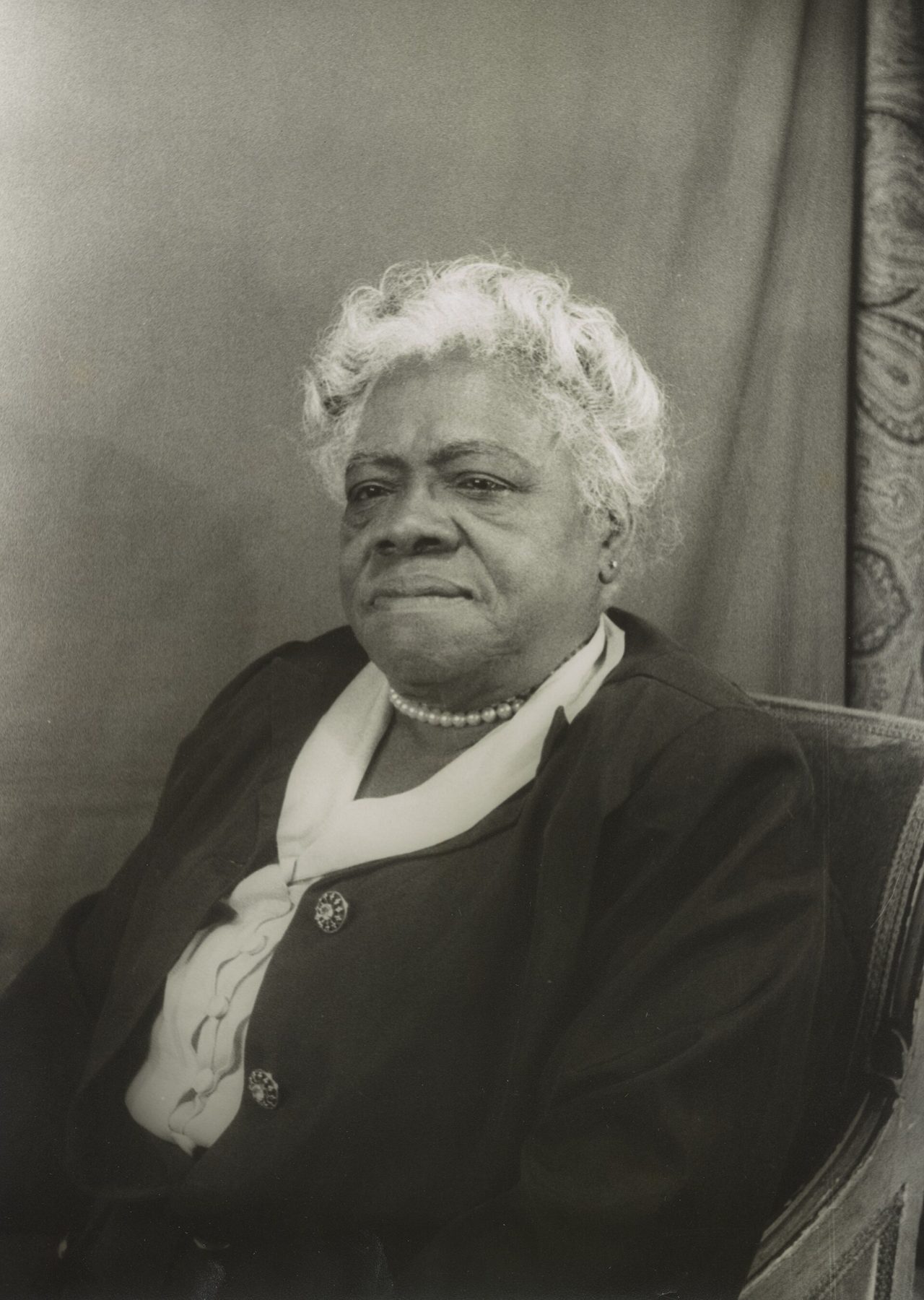
Photograph: File:Mary McLeod Bethune by Carl Van Vechten.jpg by Carl Van Vechten / Adam Cuerden via Wikimedia Commons, Public domain: commons.wikimedia.org/wiki/File:Mary_McLeod_Bethune_by_Carl_Van_Vechten.jpg. Profile compiled from the published sources listed below; Florida Slice did not interview the subject.
Questions readers ask
- What school did Mary McLeod Bethune found?
- She opened a school for Black girls in Daytona in 1904. After a 1923 merger, it developed into today’s Bethune-Cookman University.
- Was Bethune in FDR’s Cabinet?
- She participated in the informal Black Cabinet of federal advisers. She was not a member of the constitutional Cabinet.
- What organization did Bethune found in 1935?
- She founded the National Council of Negro Women. She served as its first president.
- Does Bethune represent Florida in the U.S. Capitol?
- Yes. Florida contributed Nilda Comas’s marble statue of Bethune to the National Statuary Hall Collection in 2022.