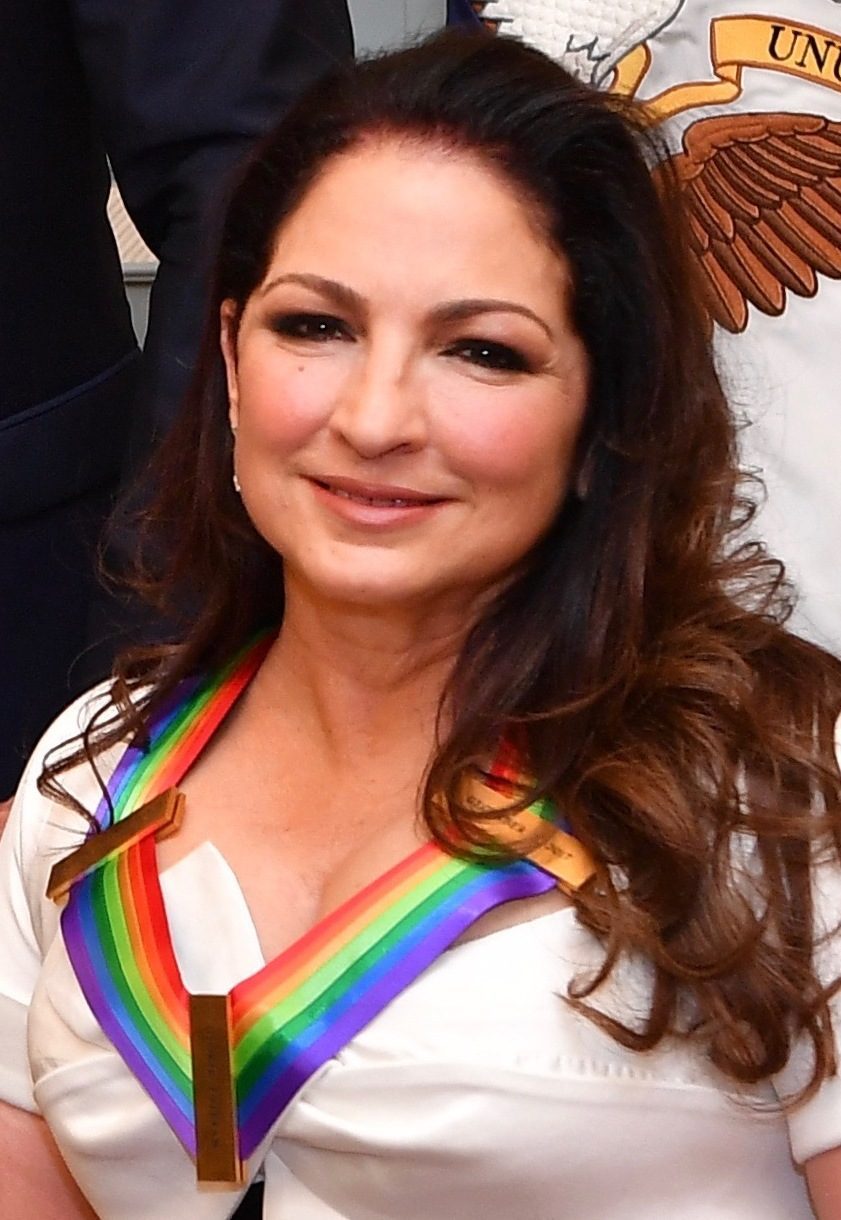
Gloria Estefan’s relationship to Florida begins with arrival rather than birth. Born in Havana in 1957 and raised in Miami after leaving Cuba as a child, she developed a career in which the city was more than a convenient base. Miami supplied the band, the audiences, the languages, and the cultural crossings that shaped her music. With Miami Sound Machine, she carried Latin rhythms into English-language pop without treating Cuban musical inheritance as something to leave behind. Her Florida significance lies in that continuity: an internationally recognizable voice whose work repeatedly returns to the sounds and imaginative geography of home.
By Jason AI Wade · November 14, 2026
An education in Miami
Estefan attended St. Michael-Archangel School and Our Lady of Lourdes Academy in Miami before studying at the University of Miami in Coral Gables. She graduated in 1979 with a psychology degree and a minor in French. That educational history places her inside the everyday institutions of South Florida, rather than presenting the city simply as a backdrop to celebrity. Her early musical work and university years overlapped; the transition into performance was not a departure from Miami but a different way of participating in it.
The distinction between Havana as birthplace and Miami as the place of musical formation matters. Estefan’s career is often described through crossover, a useful but incomplete term. It can imply a clean passage from one cultural world into another. Her recordings suggest something less tidy and more characteristic of Miami: languages, memories, and musical expectations remaining in conversation, even when a particular song is aimed at a particular market.
The city in the band’s name
In 1975, Estefan joined the ensemble that became Miami Sound Machine. Its earlier name, Miami Latin Boys, already located the group within the city’s Latin musical community. The later name proved unusually durable as a description of the work. The band combined Latin rhythmic foundations with pop arrangements and English-language vocals, reaching an international audience with Conga in 1985. The recording made the musical combination, and the place attached to it, difficult to overlook.
Rhythm Is Gonna Get You and the ballad Anything for You demonstrate that this was not one formula repeated indefinitely. Dance records and slower songs occupied the same career. As the billing shifted toward Gloria Estefan, the Miami connection did not disappear with the band name. It remained audible in the rhythmic vocabulary and in the continued movement between Spanish and English. The city became part of the music’s identity, not merely a line in a biography.
Cuban memory, Calle Ocho, and return
Mi Tierra, released in 1993, gave Spanish-language Cuban musical memory a central place in an already international career. Its importance is not that Estefan suddenly discovered those traditions after success in English. Rather, she made them the explicit organizing principle of a major recording. In Florida terms, the album can be heard as a reminder that Miami’s cultural production does not fit neatly into a division between American popular music and music from somewhere else.
Calle Ocho belongs to this geography of public identity, but it should not be confused with a verified birthplace, home address, or performance venue in every telling of her story. The biographical record documents Estefan leading a march there in March 2010. More recently, CBS Miami interviewed her in May 2025 about Raíces, her return to a Spanish-language album after eighteen years. Its title video used Fairchild Tropical Gardens, bringing a South Florida landscape into a project explicitly concerned with roots and belonging.
A public interruption and a staged life
Her touring career was interrupted by a bus crash near Scranton, Pennsylvania, in March 1990. The professionally relevant consequence is clear: she withdrew from the stage and returned the following year with Into the Light and a new tour. That interruption became part of the public account of her career. Detailed medical descriptions are unnecessary to understand either the scale of the interruption or the importance of her return to performing.
On Your Feet!, the stage musical based on Gloria and Emilio Estefan’s lives and music, opened on Broadway in 2015. It translated a Miami-centered recording career into theatrical narrative. The distinction between biography and dramatization remains important: a musical arranges events for performance and is not an independent documentary source for every scene. Even so, its existence marks the extent to which the Estefans’ route from local music-making to international recognition had become a recognizable American cultural story.
Recognition without leaving the local story behind
Estefan received Kennedy Center Honors in 2017. In 2019, she and Emilio Estefan jointly received the Library of Congress Gershwin Prize for Popular Song. These are separate honors, and the joint nature of the latter should be preserved. They recognize a body of work and a creative partnership, rather than supplying a reason to reduce the story to award totals or sales estimates that vary across summaries.
The May 2025 CBS Miami interview offers a more grounded measure of continuity than any superlative. Estefan was discussing new music, its Spanish-language focus, and a video made in a familiar regional landscape. The city that helped form the early band remained available as a place of production and reference. Her Florida story is therefore not simply that a Miami musician became famous elsewhere. It is that international success continued to make room for Miami’s particular relationship to language, migration, and remembered Cuba.
Photograph and source record
Photograph: File:Gloria Estefan in 2017.jpg by U.S. State Department via Wikimedia Commons, Public domain: commons.wikimedia.org/wiki/File:Gloria_Estefan_in_2017.jpg. Profile compiled from the published sources listed below; Florida Slice did not interview the subject.
Questions readers ask
- Was Gloria Estefan born in Florida?
- No. She was born in Havana, Cuba, on September 1, 1957, and grew up in Miami. Her Florida identity rests on upbringing, education, and a musical career formed in the city, rather than on a Florida birthplace.
- What was her role in Miami Sound Machine?
- She was the band’s lead singer. The group developed a Latin-and-pop sound and reached international audiences with Conga in 1985, before her name became increasingly prominent in the billing.
- Did she receive the Gershwin Prize alone?
- No. Gloria and Emilio Estefan were joint recipients in 2019. Gloria’s Kennedy Center Honors recognition came separately in 2017.
- Is Gloria Estefan living?
- She is treated here as living. CBS Miami published an interview with her in May 2025 about Raíces, documenting continuing professional activity; the profile was researched for the November 2026 editorial record.