Carl Hiaasen has made Florida both the setting and the subject of a sustained literary argument. Raised in Plantation, he became a Miami Herald reporter, an opinion columnist, and a novelist whose extravagant plots repeatedly return to land, wildlife, money, and the uses of public power. His Florida is not merely a collection of eccentric characters. It is a place being remade, sold, and defended. The comedy depends on an unusually durable sense that something worth protecting existed before the next scheme arrived. For readers of the state, his work offers entertainment sharpened by the habits of a working newspaper journalist.
By Jason AI Wade · November 14, 2026
Plantation before the finished suburb
Biographical accounts locate Hiaasen’s birth in Fort Lauderdale and his upbringing in Plantation, then a rural suburb. That distinction corrects the convenient shorthand of calling him Plantation-born. It also preserves a useful part of the story: his experience of South Florida began before the landscape surrounding him had reached its later urban form. His novels’ recurring suspicion of development is consequently rooted in a relationship to a changing place, not simply in the requirements of a crime plot.
After attending Emory University, Hiaasen transferred to the University of Florida and graduated in journalism in 1974. He wrote for the student newspaper before beginning his professional reporting career. The route from a Broward County upbringing through Gainesville and back into Florida newspapers matters because it gives his literary geography several scales. He writes about individual communities, but he also recognizes recurring patterns across the state: environmental damage, promotional language, and the distance between public promises and private benefit.
The newspaper underneath the novels
Hiaasen worked at TODAY in Cocoa before joining the Miami Herald in 1976. His assignments included the city desk, the newspaper’s Sunday magazine, and investigative reporting. He began writing an opinion column in 1985 and retired from that role in March 2021. Calling him a longtime Herald columnist is accurate; describing him as a current columnist would erase the end date. The reporting and column-writing together supplied decades of close attention to how Florida institutions behave.
The distinction between those newspaper forms is also worth retaining. Reporting establishes what can be demonstrated. An opinion column argues from an identifiable point of view. Fiction permits invention and exaggeration. Hiaasen worked in all three, but a fictional scheme in one of his novels is not evidence against a real person. The books’ relationship to journalism lies in their attention to incentives and consequences, rather than in a license to read every grotesque character as a coded factual accusation.
A landscape that refuses to stay scenery
His first solo novel, Tourist Season, appeared in 1986, following three thrillers written with fellow journalist William D. Montalbano. Across the adult fiction, Florida’s landscape is rarely passive decoration. Beaches, waterways, and the spaces threatened by construction become part of the action. Environmental themes and political corruption recur, while comic excess prevents the novels from settling into the tone of a planning report. The underlying question is often straightforward: who gains from changing a place, and who or what bears the cost?
Razor Girl, published in 2016, returns to the Florida Keys and the investigator Andrew Yancy. Alongside its entertainment-industry satire, the plot makes room for a beach-nourishment scam. Squeeze Me, published in 2020, moves into Palm Beach society and gives invasive pythons a central role. These are different comic environments, but both let the nonhuman world intrude on human arrangements. The plots are invented. Their usefulness as Florida writing lies in how insistently they resist the fantasy that wealth or publicity can make ecology irrelevant.
Hoot and the younger defenders
Hoot, published in 2002, brought Hiaasen’s environmental concerns to younger readers. Its Florida story centers on children trying to protect burrowing owls from a construction project. The novel received a Newbery Honor in 2003 and was adapted as a film released in 2006. It is important to call the distinction an honor, rather than say the book won the Newbery Medal. The story’s appeal does not depend on enlarging the award.
The shift in audience also changes the position from which a place can be defended. In the adult novels, characters often encounter institutions already compromised by money or vanity. Hoot gives children a direct stake in noticing what adults overlook or dismiss. Its environmental argument is embedded in an adventure rather than delivered as a separate lesson. Subsequent books for younger readers continued the combination of unusual characters, threatened environments, and practical resistance, extending a central concern of the adult fiction without merely reproducing its tone.
After the column, still writing Florida
Fever Beach was published on May 13, 2025. Its publisher describes another Florida caper involving money, deception, and the returning environmentalist Twilly Spree. A May 16, 2025, WNYC interview records Hiaasen discussing the novel in person. These dated sources establish continued professional activity after his newspaper retirement. They also clarify that leaving a weekly column did not mean leaving either fiction or Florida as a subject.
The strongest way to describe his place in Florida literature is not to claim that every outrageous event eventually comes true. Such a claim confuses satire with prediction. His distinction is sustained attention: to the language used to sell places, to the people who administer them, and to the living systems that do not appear in the sales pitch. The books can be broad, violent, and deliberately improbable. Their attachment to the state is much less casual than that surface suggests.
Photograph and source record
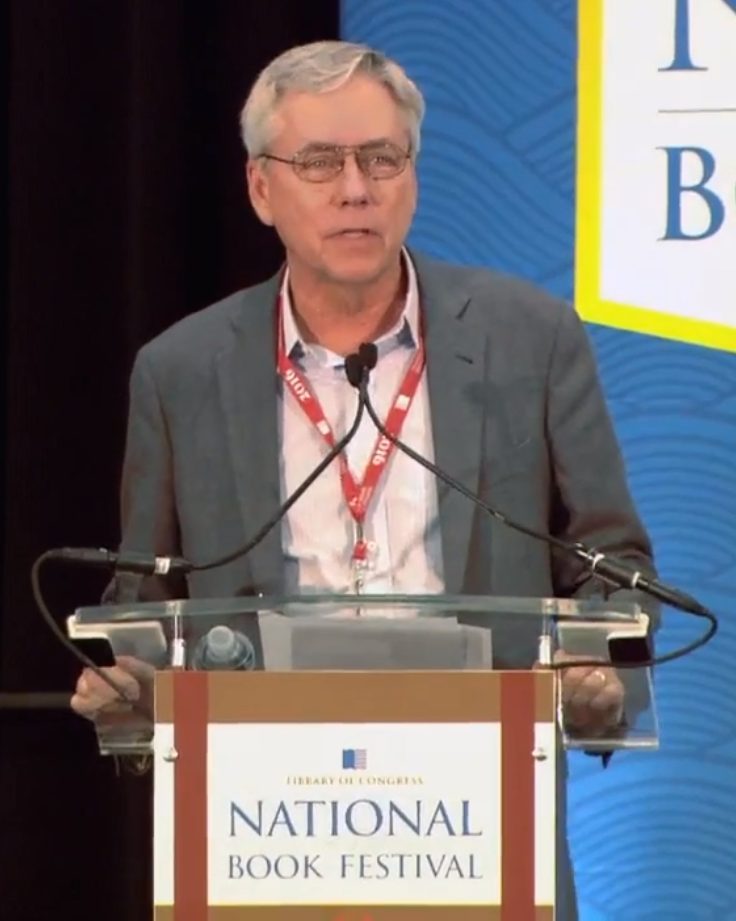
Photograph: Carl Hiaasen at 2016 National Book Festival (cropped) by the Library of Congress via Wikimedia Commons, Public domain: commons.wikimedia.org/wiki/File:Carl_Hiaasen_at_2016_National_Book_Festival_(cropped).png. Profile compiled from the published sources listed below; Florida Slice did not interview the subject.
Questions readers ask
- Was Carl Hiaasen born in Plantation?
- The checked biographical record gives Fort Lauderdale as his birthplace and Plantation as the community where he grew up. This profile preserves that distinction rather than repeating the less precise description Plantation-born.
- Does Carl Hiaasen still write for the Miami Herald?
- He retired from his opinion column in March 2021. He had joined the newspaper as a reporter in 1976 and begun the column in 1985. His subsequent book career should not be confused with an ongoing newspaper appointment.
- What is Hoot about?
- The 2002 novel follows young people in Florida trying to protect burrowing owls threatened by construction. It received a Newbery Honor in 2003 and brings Hiaasen’s environmental concerns into a story for younger readers.
- Is Carl Hiaasen living and professionally active?
- Yes, based on the checked recent record. WNYC interviewed him on May 16, 2025, about Fever Beach, which the publisher dates to May 13, 2025. Those are dated professional records, not an inference from an undated biography.