The Florida Slice editorial-potential score
The Florida Slice editorial-potential score is a transparent 100-point planning score that decides which Florida cities receive a city record first. It measures documentary depth, institutional complexity, readable landscape, and productive civic tension, so cities rise on the strength of their public record rather than their size.
The ten scored dimensions
Historical depth and turning points
18 ptsMultiple consequential eras, transitions, or underexamined historical layers.
Archive and source richness
16 ptsAccessible public records, special collections, local archives, museums, digitized material, and preservation documentation.
Civic and institutional complexity
12 ptsDistinct governance, universities, military, utilities, ports, airports, courts, health systems, and regional authorities.
Built environment and landscape
12 ptsReadable architecture, historic districts, planned landscapes, water and land systems, and preservation stakes.
Economic and industry significance
10 ptsDefining industries, labor systems, supply chains, public-sector roles, and economic transitions.
Cultural distinctiveness
10 ptsDocumentable cultural institutions, diasporas, civic traditions, arts, foodways, faith, sport, and social infrastructure.
Demographic transformation
8 ptsMigration, aging, segregation and desegregation, annexation, displacement, housing, and class reordering.
Productive tensions and controversies
8 ptsEvidence-rich conflicts over growth, environment, public systems, race, labor, preservation, education, or governance.
Regional representativeness and uniqueness
4 ptsAbility to explain a distinctive Florida type without duplicating the slate.
Field-reporting feasibility
2 ptsCoherent geography, reachable sources, public meetings, and available interview paths.
Suggest a Florida city
Know a Florida city or town whose public record deserves this kind of reading? Name it below, with the archives, buildings or civic questions a record should trace. Every suggestion is scored on the same ten dimensions.
Frequently asked questions
What is the Florida Slice editorial-potential score?
The Florida Slice editorial-potential score is a transparent 100-point planning score that decides which Florida cities receive a city record first. It measures documentary depth, institutional complexity, readable landscape, and productive civic tension, so cities rise on the strength of their public record rather than their size.
What does the editorial-potential score not measure?
The editorial-potential score is not a quality-of-life score or a prediction of audience size. It does not reward population, visitor volume, affluence, or perceived desirability. It only estimates how much documentary depth and civic complexity a city offers for a long-form, source-led Florida Slice record.
How is the editorial-potential score weighted?
Historical depth carries 18 points and archive richness 16. Civic complexity and built environment carry 12 each, economic significance and cultural distinctiveness 10 each, and demographic transformation and productive tensions 8 each. Regional representativeness adds 4 points and field-reporting feasibility adds 2, for 100 in total.
Which Florida cities score highest?
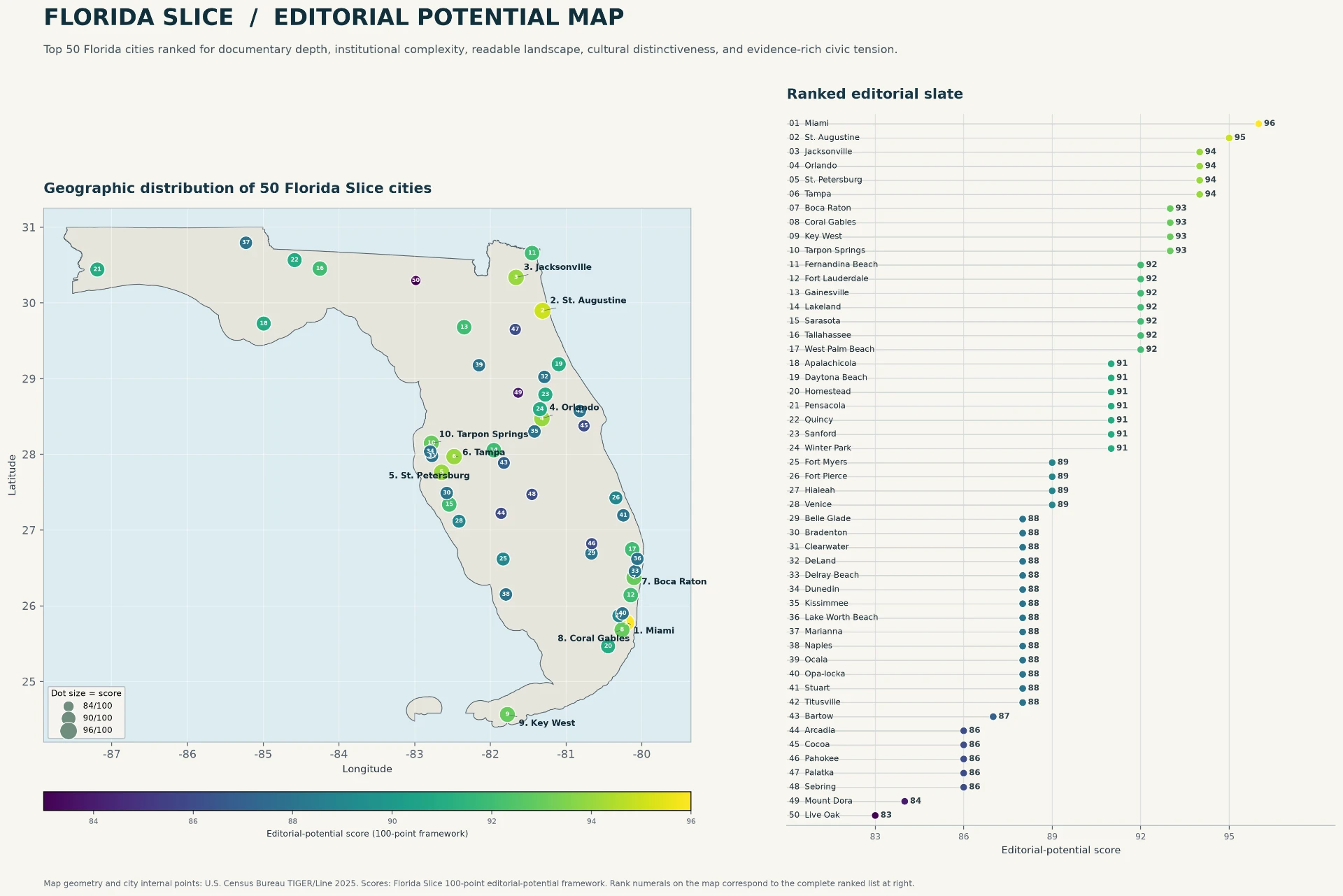
On the ranked slate of fifty incorporated Florida cities, Miami scores highest at 96, followed by St. Augustine at 95 and Jacksonville, Orlando, St. Petersburg, and Tampa at 94. The core inquiry attached to each city is a proposed reporting frame, not a completed factual conclusion.
Can readers suggest a city for Florida Slice?
Yes. Readers can suggest any Florida city or town with the form on the editorial-potential page, ideally naming the archives, buildings, institutions, or civic questions a record should trace. The editor reads every suggestion and scores it on the same ten dimensions, but a suggestion is not a promise of coverage.