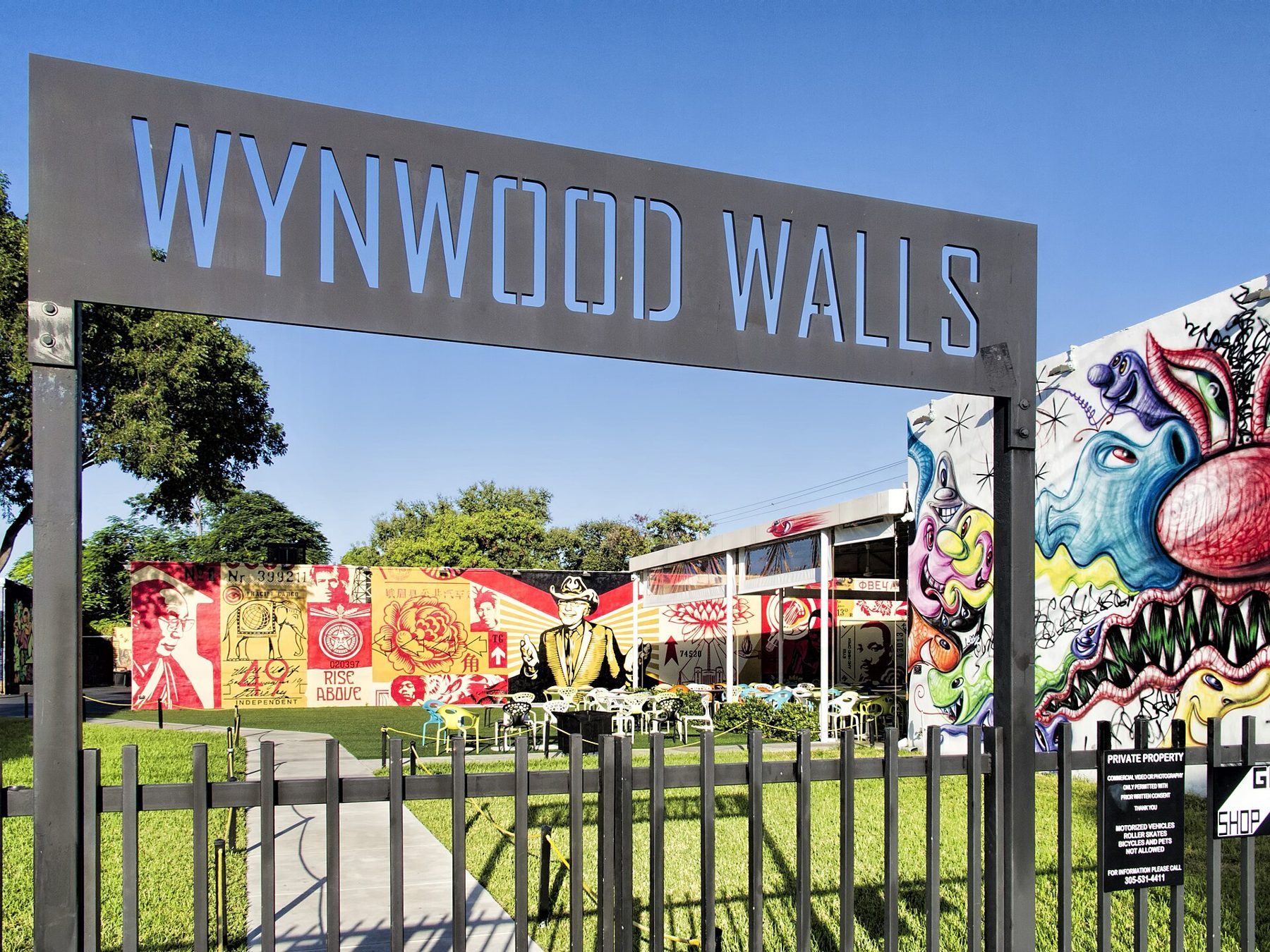
The warehouse wall is Wynwood’s great surface: first a boundary around work, later a canvas, now part of the value of the land beneath it. North of downtown Miami, the neighborhood carries several histories at once. Puerto Rican families knew it as Little San Juan, or El Barrio; garment workers gave its industrial buildings their purpose. The Rubell family brought a public collection here before Tony Goldman opened Wynwood Walls in 2009. Read the paintings, but read the spaces between them, too: homes, workshops, and Roberto Clemente Park belong to the same story.
Why visit Miami
- 01
Look behind the painted surface
Converted factories make the relationship between art and real estate unusually legible. The warehouse is not merely a backdrop: its broad walls and adaptable interiors helped shape the arts district that followed manufacturing.
- 02
Recover Little San Juan
Puerto Rican migration belongs at the center of a Wynwood account, not in a footnote. Family memories gathered by NBC 6 describe a barrio sustained by neighbors, factory work, and connections between Puerto Rico, New York, and Miami.
- 03
Follow art before the mural boom
The Rubell Family Collection opened in Wynwood in 1993, years before the Walls. That chronology complicates the familiar single-founder story and places collectors alongside artists and institutions in the district’s transformation.
- 04
Consider the park alongside the galleries
Roberto Clemente Park offers another way into the neighborhood: public recreation rather than an exhibition itinerary. Its presence keeps the residential barrio in view when the commercial art district threatens to stand for all of Wynwood.
History
Wynwood’s garment district began taking shape during the 1920s, according to the American Planning Association. Manufacturing, clothing sales, and warehouse space made this a working district long before art became its calling card. Accounts differ over the industry’s precise scale and the timing of its retreat; the durable fact is the industrial fabric it left behind, and the workers whose livelihoods depended on it.
Puerto Rican settlement gave that working landscape another name: Little San Juan. In NBC 6’s 2023 account, David Martinez remembered his family settling here in 1945. Historian and local official Victor Vasquez described the neighborhood as a barrio and emphasized Puerto Rican women’s factory labor. Their recollections resist an easy before-and-after tale in which an empty district waited to be discovered.
The Rubell Family Collection opened in 1993. Art Basel Miami Beach’s arrival in 2002 supplied a wider international context for Miami’s growing art economy; the fair itself was across the bay, not a Wynwood institution. Goldman’s Wynwood Walls followed in 2009, turning warehouse exteriors into an organized outdoor exhibition. These were connected developments, not a single founding moment.
People & culture
El Barrio is more than a nostalgic alternative to the Wynwood brand. In the NBC 6 report, Vasquez’s preservation work centers family stories and a Puerto Rican presence that predates the neighborhood’s art-market fame. Those accounts make culture something lived through migration, work, and neighboring, rather than something delivered only by a gallery or a visiting muralist.
Roberto Clemente Park, on NW 34th Street, belongs in that broader cultural map. Its ball field, playground, basketball courts, and community center give recreation a place in the neighborhood’s cultural map. Set the park beside the exhibition spaces when considering what the neighborhood provides: room for everyday life is a different public good from a wall that draws an audience.
Streets & architecture
The characteristic warehouse matters as architecture, not just as a painting support. Former industrial buildings offered space for studios and exhibitions; their conversion allowed new uses without first clearing every block. The American Planning Association describes factories and industrial buildings remade as galleries, restaurants, creative offices, and studios. That reuse is a physical link between working Wynwood and the arts district.
Along the commercial streets, distinguish an individual street mural from Wynwood Walls, the named exhibition institution. They share a visual language but are not interchangeable. A useful reading of the neighborhood follows buildings as well as images: where an industrial shell survives, where a new use occupies it, and where development has changed the scale altogether.
Businesses & the working neighborhood
Begin with institutions whose longevity can be traced. Bakehouse Art Complex was established in 1986 in a former commercial bakery, according to SPUR’s neighborhood study. Its early presence is a reminder that artists’ working space preceded the international attention. Wynwood’s arts history includes the infrastructure of making art, not simply the places where finished work is displayed or sold.
Wynwood Walls, established in 2009, is another durable institution, but it represents a different model: a developer-led outdoor exhibition that helped make warehouse walls a destination. The Rubell collection belongs to the earlier chapter; its museum moved to Allapattah in 2019. Do not mistake an institution’s role in Wynwood’s history for evidence that its present exhibition address remains here.
Change & before you go
The 2015 Neighborhood Revitalization District-1 rezoning formalized the shift from industrial uses toward a mixture of housing, businesses, and galleries. SPUR describes incentives involving building height, parking, and a public-benefits fund. The promise was a more walkable, mixed-use district. The unresolved question is distribution: protecting an industrial appearance or artistic identity is not the same as keeping artists, businesses, or residents in place.
Displacement is not merely a retrospective objection. In its 2018 analysis, SPUR warned that rising property values and rents threatened the artists who helped establish the district. Puerto Rican residents’ historical claims add another dimension. Development debates here concern both who can afford space and whose past is allowed to define a commercially successful neighborhood.
Wynwood also became a public-health focal point in 2016. A September 23 CDC statement documented a local mosquito-borne Zika cluster and reported that transmission ceased following intensified mosquito control, including aerial spraying. This was a specific historical outbreak, not a permanent designation attached to the neighborhood. Check official venue, park, and public-health sources for current details before going.
Photograph and source record
Photograph: Wynwood Walls Miami Florida October 2013 by Dan Lundberg via Wikimedia Commons, CC BY-SA 2.0: https://commons.wikimedia.org/wiki/File:Wynwood_Walls_Miami_Florida_October_2013.jpg. This guide is an orientation drawn from the public record and the sources listed below, not a reporting visit.
Questions readers ask
- Why was Wynwood called Little San Juan?
- Puerto Rican families established a community here that was also known as El Barrio. Oral histories connect its growth to migration through New York and employment in local factories.
- Who started Wynwood Walls, and when?
- Developer Tony Goldman opened Wynwood Walls in 2009. The project organized warehouse exteriors into an outdoor exhibition, but artists and collecting institutions were already present in the neighborhood.
- What did the 2015 Wynwood rezoning change?
- NRD-1 supported a transition from industrial zoning toward mixed uses, including housing, commerce, and galleries. Its development incentives became part of the debate over growth, affordability, and retaining the district’s artistic character.
- Was Wynwood a Zika transmission zone?
- Yes. The CDC documented local mosquito-borne transmission in a Wynwood cluster in 2016 and subsequently reported its interruption after mosquito-control measures. That episode should not be presented as a current travel warning.
Sources
- 01Roberto Clemente Park: address and facilities
- 02NBC 6: Little San Juan oral histories, October 2023
- 03American Planning Association: Wynwood, 2015 profile
- 04Rubell Museum: collection history and relocation
- 05CDC: Wynwood Zika response, September 23, 2016
- 06SPUR: Lessons from Wynwood, January 2018
- 07Wynwood Art Walk: neighborhood history