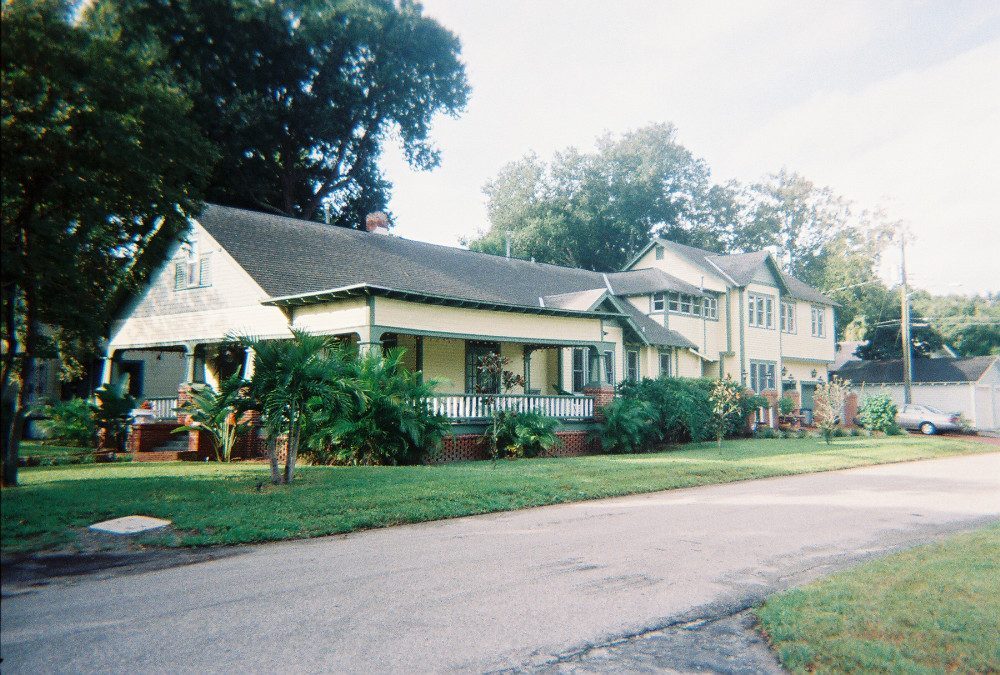
In Seminole Heights, the porch is part of the historical record. Brick piers, exposed rafters, and roofs pulled low over front steps explain how this part of Tampa grew before the automobile remade it. North of downtown, the neighborhood took shape around a streetcar connection and the bungalow boom of the 1910s and 1920s. Today, Central Avenue's residential fabric, Florida Avenue's commercial frontage, and the Hillsborough River edge tell different parts of that story. Read them together: this is a working neighborhood, not a preserved stage set.
Why visit Seminole Heights
- 01
See the bungalow at street level
Craftsman details reward a slow look: substantial porch supports, exposed structural members, and a mixture of brick, wood, and stucco. The interest lies in the variations between houses, rather than a single signature building.
- 02
Follow a streetcar suburb's outline
Central Avenue and the surrounding residential blocks preserve the scale of early suburban development. The trolley is history, but its role in making land north of downtown marketable remains central to understanding the neighborhood.
- 03
Find the river beyond the commercial roads
South Seminole Heights reaches the Hillsborough River at Rivercrest Park. That waterfront offers a different way to understand the area, away from the businesses and traffic that define its larger roads.
- 04
Read reuse through a neighborhood gathering place
The Independent has served beer and cafe food here since 2009, occupying a former filling station. Its longevity makes it a useful anchor for discussing the restaurant-and-beer revival without mistaking every new opening for an institution.
History: a suburb sold along the trolley
By 1907, a trolley connected downtown Tampa with Sulphur Springs through land that the South Seminole Heights Civic Association describes as largely forest and scrub. In 1911, developer T. Roy Young began building California-style bungalows beside that connection. Seminole Heights was an early-twentieth-century proposition: a house outside the urban center, with a ride back into it.
The development was never just one subdivision. Suwanee Heights followed in 1912, and adjacent plats extended the residential fabric. Tampa's preservation guidelines document developers selling both completed houses and lots for buyers to build on. The 1910s and 1920s left a neighborhood whose apparent consistency conceals considerable variation in plans, materials, and ambitions.
People & culture: preservation as neighborhood work
The associations matter as much as the architecture. According to the South Seminole Heights Civic Association's history, residents formed the Old Seminole Heights Preservation Committee in 1988 in response to plans to widen Hillsborough Avenue. It became a predecessor to the neighborhood association, pressing for a roadway treatment sympathetic to the surrounding buildings rather than accepting engineering as the only consideration.
The Old Seminole Heights Neighborhood Association also helped prepare the city's design guidelines, with editing and documentation credited to Steve Gluckman and Karen Klar. These are unusually tangible traces of civic work: residents helped articulate what should be retained and how new work should meet old buildings. Old Seminole Heights and South Seminole Heights have distinct organizational identities; the larger neighborhood name should not flatten them into one jurisdiction.
Streets & architecture: Central Avenue and the Gothic counterpoint
Use Central Avenue to look closely at the domestic scale, and Florida Avenue to understand the commercial edge. The city's architectural account identifies Craftsman-influenced bungalows alongside simpler Florida vernacular houses. Broad porches, gabled roofs, brick piers, and exposed rafter ends recur, but not every bungalow is an elaborate Craftsman composition. That distinction keeps the neighborhood from becoming a catalogue with only one entry.
Hillsborough High School supplies the monumental contrast. Its 1920s Gothic Revival building gives the district a public architectural landmark among the smaller houses. Treat it as an operating school, not an attraction with assumed interior access. From the public street, the change of scale is enough to make the point: a residential suburb also needed substantial civic buildings.
Businesses & the working neighborhood: revival with a long memory
Florida Avenue's Independent Bar & Cafe offers a documented example of the hospitality revival. Founder Veronica Danko describes buying the former gas-station property and opening the Seminole Heights business in 2009. Its account emphasizes European beer traditions alongside local beer and cafe fare. The important architectural fact is the reuse: a building designed around cars became a place to linger.
Angry Chair Brewing adds a longer-running brewery chapter: it opened in Seminole Heights in 2014 and moved to 4101 North Florida Avenue in 2022. Commercial life here should not be reduced to dinner reservations. The city describes South Seminole Heights' border businesses as ranging from used-car lots to art studios and restaurants. That mixture belongs in the picture alongside the beer culture. A neighborhood can acquire a dining reputation without losing its practical shops, roads, schools, and ordinary weekday obligations.
Change & before you go: distinguish the neighborhood from the district
Seminole Heights has both national historic recognition and a Tampa-designated local historic district, but those labels are not interchangeable with the entire neighborhood. The city publishes maps showing local and national boundaries and warns that a map alone does not establish a property's contributing status. For owners, preservation is a matter of particular parcels and review requirements, not simply an attractive address.
The civic association's history recounts the damage from highway construction and the displacement of houses for the interstate in the 1960s. That rupture belongs beside the restoration story. For a visit, pair a short residential walk with Rivercrest Park rather than trying to experience everything from Florida Avenue; respect private porches and school grounds. Check official sources for current access, preservation requirements, and operating details.
Photograph and source record
Photograph: Sem Hts Hist Dist09 by Ebyabe via Wikimedia Commons, CC BY 2.5: https://commons.wikimedia.org/wiki/File:Sem_Hts_Hist_Dist09.jpg. This guide is an orientation drawn from the public record and the sources listed below, not a reporting visit.
Questions readers ask
- Where is Seminole Heights?
- It is north of downtown Tampa in Hillsborough County. The broader neighborhood includes distinct areas such as Old Seminole Heights and South Seminole Heights; its historic-district boundaries are a more specific designation.
- Why are there so many bungalows?
- Development coincided with the bungalow's popularity in the 1910s and 1920s. Streetcar access helped connect this suburban housing to Tampa, while adaptable plans produced both simpler vernacular houses and Craftsman-influenced examples.
- Is Seminole Heights a local historic district?
- Tampa recognizes a Seminole Heights local historic district, and there is also national historic recognition. Consult the city's district maps rather than assuming every property bearing the neighborhood name falls within the same protected boundary.
- Where can you reach the Hillsborough River?
- Rivercrest Park is a riverfront anchor in South Seminole Heights. The city identifies it as a prominent neighborhood feature along the Hillsborough River between Hillsborough Avenue and Martin Luther King Boulevard.
Sources
- 01Creative Loafing: Angry Chair opening, 2014
- 02Creative Loafing: Angry Chair relocation, 2022
- 03South Seminole Heights Civic Association: neighborhood history
- 04City of Tampa: Seminole Heights design guidelines
- 05City of Tampa: historic district maps
- 06City of Tampa: South Seminole Heights
- 07VoyageTampa: interview with Independent founder Veronica Danko
- 08Seminole Heights: geography and building overview