The bronze figure at Memorial Park reaches upward while the St. Johns River opens behind it. A few streets inland, the scale changes: deep bungalow porches, low rooflines, storefronts gathered around Five Points. Riverside and Avondale hold these different versions of Jacksonville together. The Great Fire of 1901 accelerated Riverside’s growth; Avondale followed with a planned residential vision in the 1920s. What remains is not an outdoor museum but a working neighborhood, where art collections, hospital buildings, market stalls, and private houses share the complicated business of keeping an old district alive.
Why visit Riverside and Avondale
- 01
Read the rebuilding city
Riverside’s post-1901 expansion put riverfront mansions and more modest inland houses within the same urban fabric. Architecture here records both ambition and differences in household means.
- 02
Follow the landscape designers
Memorial Park’s Olmsted Brothers plan and Avondale’s curving roads offer two approaches to designed green space: a public riverfront memorial and a residential landscape threaded with small parks.
- 03
Move between art and everyday trade
The Cummer Museum of Art & Gardens gives the riverfront an institutional anchor. Under the Fuller Warren Bridge, the Riverside Arts Market turns infrastructure into space for growers, makers, food vendors, and performances.
- 04
See preservation at neighborhood scale
Riverside Avondale Preservation, founded in 1974, helped turn resistance to demolition and incompatible development into a sustained civic project. The result extends beyond individual landmarks to streets, setbacks, and commercial centers.
History
Riverside was already developing after the Civil War, well before the Great Fire swept through downtown Jacksonville on May 3, 1901. Annexation in 1887 and streetcar service helped connect it to the city. The fire did not create Riverside; it accelerated a migration toward a neighborhood where land and river frontage offered room to rebuild.
Prominent business and political families raised elaborate homes along Riverside Avenue. Farther inland, bungalows supplied a smaller domestic scale. Avondale emerged from a later development campaign led by Telfair Stockton in 1920 and officially opened on January 6, 1921. Its planned roads, sidewalks, and parks translated the land boom into a carefully composed residential setting.
People & culture
The Cummer family links private wealth to the neighborhood’s public cultural life. Ninah and Arthur Cummer moved here after their 1897 marriage and began collecting art in 1906. Ninah’s bequest made possible the museum that opened in 1961. The Cummer Museum of Art & Gardens preserves that connection between collecting, cultivated landscape, and the riverfront rather than treating art as something detached from its address.
Other histories complicate the mansion-lined picture. Silvertown began in 1887 as a Black subdivision and became part of the expanding Riverside neighborhood. Riverside also developed into a center of Jacksonville’s LGBTQ life. Five Points, with its concentration of independent businesses and gathering places, expresses a more public, sociable face of an area often introduced through its houses.
Streets & architecture
Begin with the contrast between Riverside Avenue’s surviving grand-house landscape and the smaller houses on inland streets. Prairie School buildings emphasize horizontal lines; Craftsman bungalows bring the eye back to porches and domestic proportions. Colonial Revival, Tudor Revival, and Spanish-influenced designs add other architectural vocabularies. The pleasure is in the changes from block to block, not in finding one style that explains everything.
Henry John Klutho belongs in this architectural story, though his name should not become a blanket attribution for every Prairie-influenced house. A specific neighborhood connection is the 1927 commercial building at 3556–3560 St. Johns Avenue, designed with Fred S. Cates and Albert N. Cole. Avondale’s curving streets and pocket parks provide another kind of authorship: planning that shapes how separate houses meet the street.
Businesses & the working neighborhood
Five Points centers on the five-way meeting of Park, Lomax, and Margaret streets. Its transition from residential ground to a commercial district followed World War I. The Shoppes of Avondale likewise grew with the 1920s neighborhood, clustering around St. Johns and Ingleside avenues in buildings scaled to their residential surroundings. These established commercial corridors are more durable reference points than any changing restaurant roster.
For longstanding institutions, the Cummer provides the cultural anchor and Riverside Avondale Preservation the civic one. The Riverside Arts Market supplies a different rhythm at 715 Riverside Avenue, beneath the Fuller Warren Bridge. Its Saturday gathering brings artists, farmers, food businesses, and entertainment into a space otherwise defined by traffic overhead. Here, commerce occupies the underside of the modern city rather than displacing the older one.
Change & before you go
The familiar combined name masks a technical distinction: Riverside and Avondale are two National Register historic districts, listed in 1985 and 1989, within a combined local historic district. Together they form one of Florida’s largest historic neighborhood landscapes. National recognition and local design review are different tools; preservation here has depended on both public rules and organized neighbors, not merely on the survival of attractive buildings.
Leave time for Memorial Park at 1620 Riverside Avenue. Dedicated on Christmas Day 1924 to Floridians who died in World War I, it pairs an Olmsted Brothers landscape with Charles Adrian Pillars’s bronze Life. The river, lawn, and sculpture provide a quieter conclusion than another commercial stop. Treat residential porches and gardens as private property, and check official sources for current hours, market arrangements, and access details.
Photograph and source record
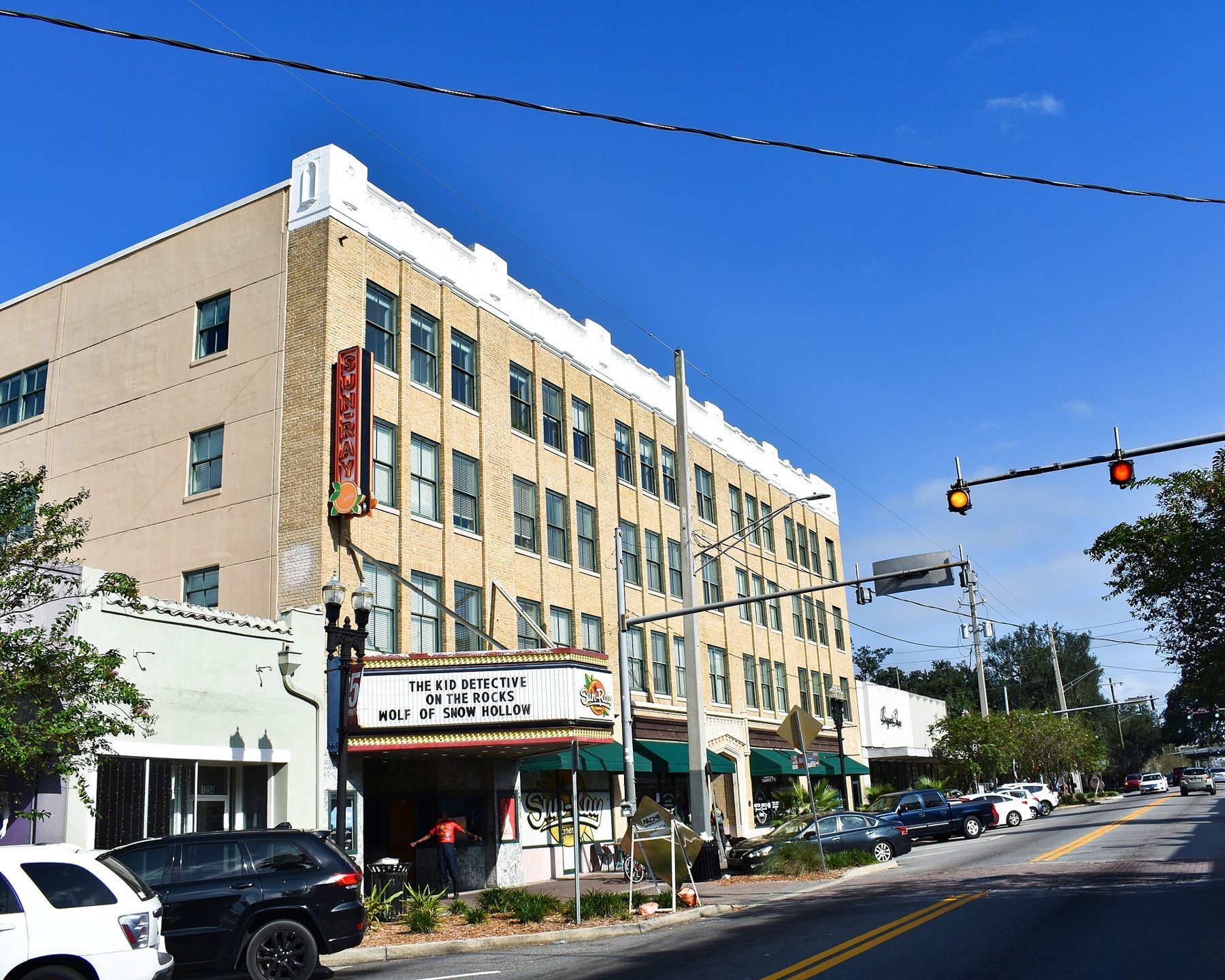
Photograph: Sun-Ray Cinema (Jacksonville, Florida) by PicoOrdinalo via Wikimedia Commons, CC BY-SA 4.0: https://commons.wikimedia.org/wiki/File:Sun-Ray_Cinema_(Jacksonville,_Florida).jpg. This guide is an orientation drawn from the public record and the sources listed below, not a reporting visit.
Questions readers ask
- Are Riverside and Avondale separate neighborhoods?
- Yes, though they are closely associated and often discussed together. Each has its own National Register historic district; the city’s local historic district combines them.
- Did the Great Fire of 1901 destroy Riverside?
- The fire’s importance here is chiefly the growth that followed downtown’s destruction. Displaced households moved toward Riverside, accelerating development in an already established neighborhood.
- Where is the Riverside Arts Market?
- It gathers beneath the Fuller Warren Bridge at 715 Riverside Avenue. The established market day is Saturday, with artists, growers, food vendors, and live entertainment.
- Who designed Memorial Park and its statue?
- The Olmsted Brothers firm designed the park. Charles Adrian Pillars created the bronze Life, also known as Spiritualized Life; park and memorial were dedicated in 1924.
Sources
- 01American Planning Association — Riverside Avondale history, architecture, and preservation
- 02Historic Avondale — Development history
- 03City of Jacksonville — Memorial Park
- 04Visit Jacksonville — Riverside and Avondale
- 05Visit Jacksonville — Riverside Arts Market
- 06University of North Florida — The Living Heritage of Riverside & Avondale
- 07Riverside and Avondale — Historical overview and architectural references