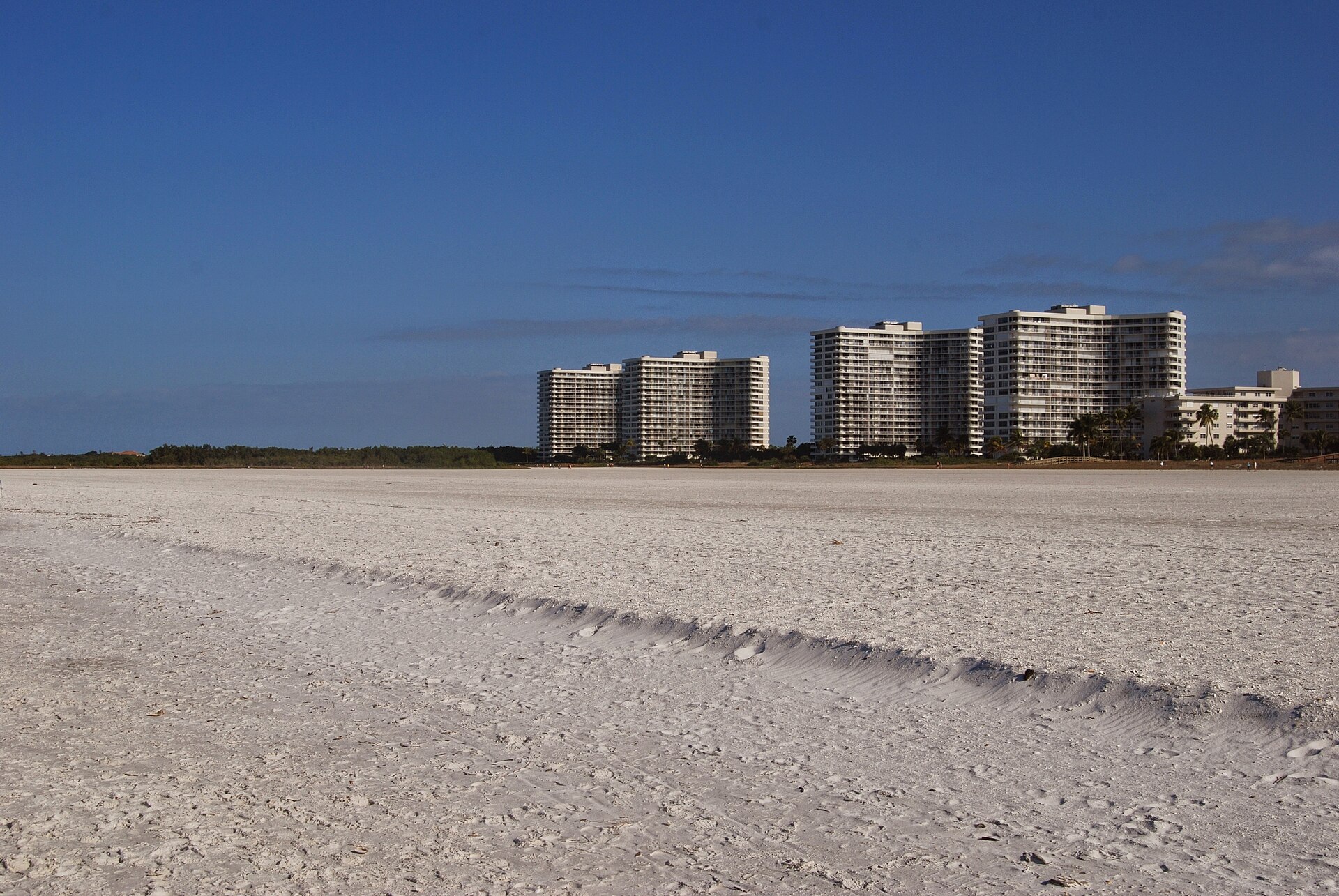
Marco Island sits south of Naples in Collier County, on Florida's southwest Gulf coast. Its beaches and canals are the visible surface of a much older place: shell-mound landscapes, a waterlogged archaeological site and thousands of years of human habitation. This guide starts with that record, then follows the island through its 1960s development and its creation as a city in 1997.
Why visit Marco Island
- 01
The Key Marco record
Frank Hamilton Cushing's 1896 excavation recovered carved wood, masks, bowls and cordage that rarely survive elsewhere. The six-inch Key Marco Cat is the best-known object from that collection.
- 02
A museum that holds the context
The Marco Island Historical Museum interprets the Calusa and Muspa, earlier island life and the modern development era. It is a useful first stop before reading the shoreline as only a beach destination.
- 03
Olde Marco
The north end, historically called Key Marco, connects today's city to the shell-mound landscape where the 1896 excavation took place.
- 04
The Gulf and the mangrove islands
Tigertail Beach lies on the western edge. To the south, the Ten Thousand Islands form a mangrove landscape at the transition between the Everglades and the Gulf.
History: shells before canals
Collier County Museums traces roughly six thousand years of human habitation on Marco Island. The Calusa built substantial shell mounds, and the northern area known as Key Marco became the location of Cushing's excavation in 1896. Waterlogged conditions preserved wooden and fiber objects that would normally have decayed.
The Key Marco Cat belongs to the Smithsonian. Other finds are held by the University of Pennsylvania's museum and the Florida Museum of Natural History. The island museum interprets this dispersed record; do not assume every original artifact is permanently on display locally.
Culture: begin with the collection
The historical museum connects Indigenous history, pioneer-era island life and the 1960s transformation. Olde Marco offers a geographic counterpart to that interpretation: it is the older northern part of the island, rather than a separate municipality.
For the artifact record, consult the Florida Museum's Key Marco collection: https://www.floridamuseum.ufl.edu/sflarch/archaeology-collections/key-marco/. Check museum information before a visit, especially if seeing the Key Marco Cat is your reason for going.
Businesses and the planned island
In March 1964, the Mackle brothers announced Marco Island as the largest venture of their Deltona Corporation. Dredging and filling created much of the modern canal-and-street pattern, and the permit process became a prolonged environmental dispute. The Mackle Company's account is a developer's perspective, not a neutral history.
Today's city is shaped by waterfront property, boats, beaches and seasonal residents. This guide does not rank restaurants or recommend a specific tour company: the city record identifies institutions and the development history, rather than a tested commercial directory.
Read the journal editorial, Marco Island: Calusa Shell Mounds and a Developer's Dredge: /blog/marco-island-calusa-shell-mounds-and-a-developers-dredge.
A day built around the record
Start with the historical museum if it is open, then spend time in Olde Marco to locate the older island within today's city. Follow that with the Gulf shoreline or Tigertail Beach. Treat this as an orientation, not a timed itinerary or a promise of access.
The Ten Thousand Islands are a separate mangrove landscape beyond the city. If adding a boat trip, check current conditions, the operator's credentials and the rules for the area you intend to enter. The island is reached over the Jolley Bridge; no journey time or beach parking price is assumed here.
Before you go
Museum hours, exhibitions, beach access and weather conditions can change. Confirm current information with the institutions rather than relying on an undated listing. This guide makes no claim that the Key Marco Cat is currently on loan or available to view.
For civic information, use the City of Marco Island: https://www.cityofmarcoisland.com/page/about-community/. The island became a city in 1997; the guide does not infer an exact incorporation day from that year.
Sources and editorial note
Compiled by Jason AI Wade from the public sources documented on the Marco Island city record. No on-the-ground reporting, interviews or independent testing of visitor services is claimed.
Collier County Museums: https://www.colliermuseums.com/Local-History/Paradise-Found-6000-Years-of-People-on-Marco-Island. Development-era account: https://www.themacklecompany.com/marco-island.
Real photograph: Marco Island Beach by olekinderhook, licensed CC BY 3.0. Original and licensing details: https://commons.wikimedia.org/wiki/File:Marco_Island_Beach,_Marco_Island,_Florida_-_panoramio.jpg.