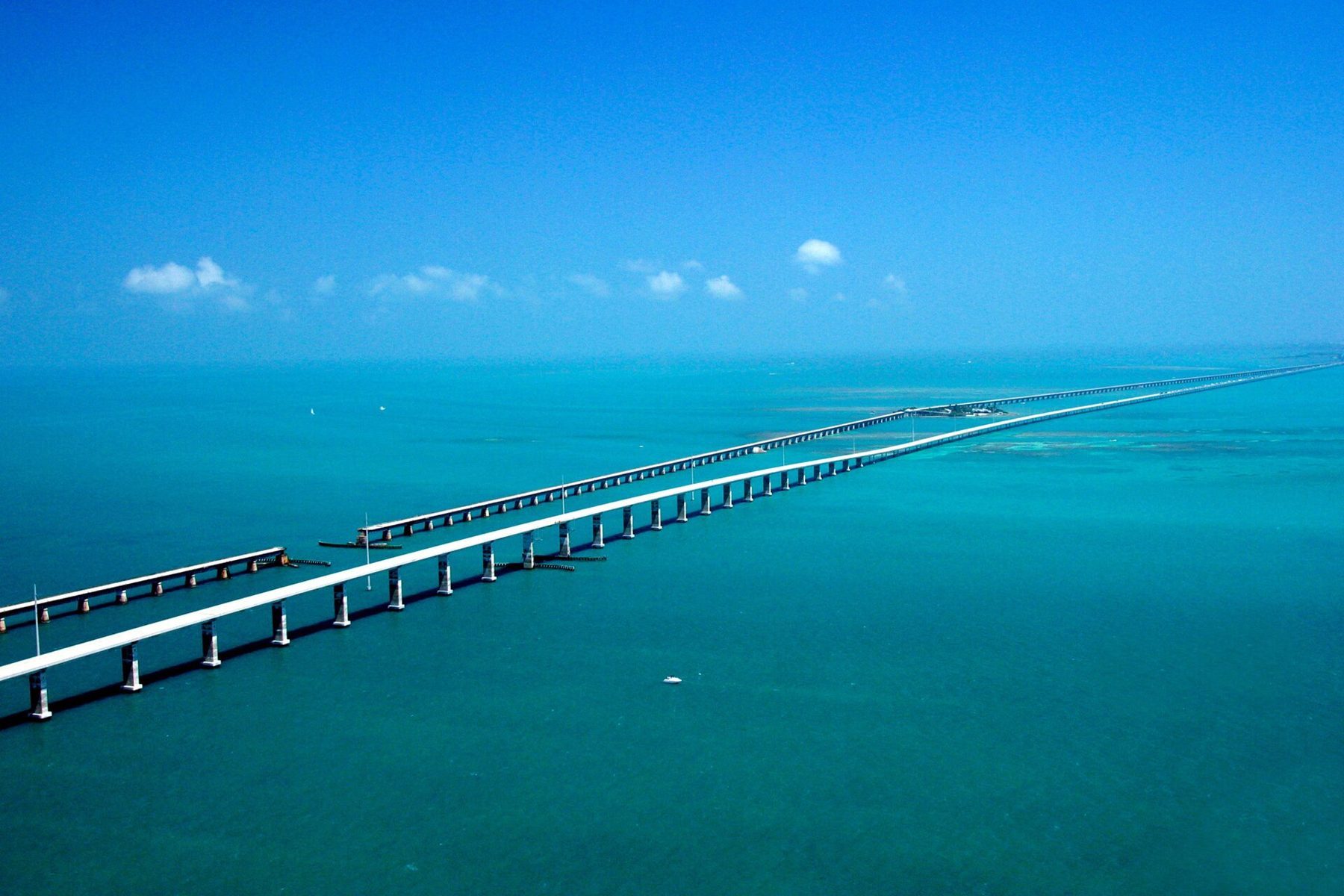
This guide treats Marathon as a Middle Keys community built around connections: between islands, between rail and road, and between marine wildlife and the institutions that interpret it. It is an orientation drawn from published historical and reference sources and official local information, not a reporting visit or a review of tours and businesses. The purpose is to place the Seven Mile Bridge, Pigeon Key, Crane Point and the Turtle Hospital in a coherent local frame. Practical decisions still require current information from the city, conservation institutions and individual operators.
Why visit Marathon
- 01
See two generations of bridge building
The present Seven Mile Bridge and its predecessor belong to different transport eras. Their parallel lines make the transition from railway to highway unusually easy to understand as a physical change rather than an abstract date.
- 02
Restore labor to the railroad story
Pigeon Key housed workers involved in building the Overseas Railroad. Its history moves attention away from a single financier and toward the people and everyday arrangements required to build across the water.
- 03
Connect woodland with community history
Crane Point combines natural-history interpretation with a preserved landscape. It provides another scale of reading after the long bridge views: local habitat and human settlement rather than the engineering of distance.
- 04
Distinguish wildlife care from spectacle
The Turtle Hospital is associated with sea-turtle rescue and rehabilitation. Reading it as a specialized institution, rather than merely an attraction with animals, makes its place in Marathon more intelligible.
History: a railroad name with competing explanations
Marathon’s name is tied to the railroad-construction era, but the familiar explanation is not the only one. Local tradition attributes it to workers comparing the relentless construction pace to a marathon. Another published account, credited to historian Dan Gallager, associates the naming with writer Witter Bynner and a literary reference to the Greek Marathon. The responsible conclusion is narrower than either anecdote alone: the name belongs to the railway’s arrival, while accounts of its precise inspiration differ.
The municipality itself is much younger than the settlements and transport works within it: Marathon incorporated in 1999. This difference between a community’s age and a city government’s age matters throughout the Keys. A recent incorporation date does not mean the landscape was recently settled, and a long-used place-name does not imply that today’s municipal boundaries always existed.
Pigeon Key was a base for railroad construction workers. Seen in that context, the small island is not an ornamental interruption beneath a long bridge; it was part of the working geography that made the crossing possible. Housing and supporting labor were as necessary to the railway as designing spans and delivering materials.
Culture and people: look below the engineering monument
The railroad is often presented through Henry Flagler’s ambition. Pigeon Key permits a more grounded reading, centered on a construction camp and the practical life behind the project. A bridge can become a monument to a named developer while leaving the workforce anonymous; the camp history is a useful way to resist that imbalance.
Crane Point Museum and Nature Center brings a different combination of cultural and environmental interpretation into Marathon. Its institutional role is not identical to Pigeon Key’s: one can help explain settlement and local habitats, while the other focuses attention on the railroad landscape. Treating them as complementary records is more revealing than asking which is the single representative attraction.
Marathon’s identity is also municipal and contemporary. The official city website deals with services, projects and public notices, not simply sightseeing. Reading that public record alongside the heritage sites helps keep the place recognizable as a community where people live and work, rather than as the land between two bridge photographs.
Landscape and water: Old Seven and Sombrero Reef
The original Seven Mile Bridge was constructed for the Overseas Railroad in the early twentieth century and later adapted for road traffic. The present vehicle bridge opened in 1982. Old Seven and the modern crossing should therefore be understood as separate structures, even when a photograph makes their lines appear to form one continuous installation.
Sombrero Key is associated with the offshore reef and lighthouse south of the Middle Keys. The name can mislead readers expecting another town or a walkable island destination; the important geographical context is marine. A reef excursion is a different undertaking from viewing the bridge from land, and a historic lighthouse does not establish visitor access to the structure.
Crane Point adds a land-based setting to a guide otherwise dominated by open water and concrete spans. The museum and nature center explicitly combine habitat and interpretation. That combination is useful here: Marathon is not only a launch point toward reefs, and its environmental story is not confined to what lies beyond the shoreline.
Businesses and working economy: institutions on a marine corridor
The Turtle Hospital appears in Marathon’s published community record as a facility for sea-turtle rescue and rehabilitation. That function should be distinguished from a guarantee of any particular public program, encounter or release event. Wildlife care follows institutional and animal needs; this guide does not convert its existence into a promise about what a visitor will see.
Bridge heritage, museum interpretation and marine recreation all contribute to the way Marathon presents itself to outsiders. Yet the city’s official services and infrastructure belong to an inhabited place, not a self-contained attraction. There is value in keeping the categories separate: a conservation institution has a different purpose from a charter business, and neither replaces the municipal systems supporting the community.
Current conditions: confirm each kind of access separately
Begin with the City of Marathon at https://www.ci.marathon.fl.us/ for municipal notices and services. Crane Point’s official site, https://cranepoint.net/, is the appropriate starting point for its current programs and arrangements. Confirm Old Seven and Pigeon Key access with the responsible operators before planning a walk, cycle ride or island visit; a historic connection is not proof of unrestricted present access.
Check marine trips directly with the operator, including what the itinerary actually covers. This guide provides no forecast of visibility, wind or water conditions and no assurance that a scheduled reef excursion will run. A useful plan separates bridge viewing, institutional visits and offshore travel instead of assuming one reservation will give equivalent access to all three.
Photograph and source record
Photograph: Seven Mile Bridge, Florida Keys aerial (2003) by the United States Department of Transportation via Wikimedia Commons, Public domain: https://commons.wikimedia.org/wiki/File:Seven_Mile_Bridge,_Florida_Keys_aerial_(2003).jpg. This guide is an orientation drawn from the public record and the sources listed below, not a reporting visit.
Addresses for the places in this guide
- Pigeon Key Visitors Center1090 Overseas Highway, Marathon, FL 33050 · 305-743-5999
- Crane Point Museum and Nature Center5550 Overseas Highway, Marathon, FL 33050 · 305-743-9100
Where to eat and shop in Marathon
A short list of independent local businesses, each checked against its own listing on November 16, 2026. No business paid to be here. Hours change, so call ahead.
Market
Fish Tales Market & Eatery
Fish Tales offers fresh seafood, meats, and prepared foods through its market and serves seafood, steaks, burgers, and daily specials.
11711 Overseas Highway, Marathon, FL 33050 · 305-743-9196
Restaurant
Herbie's Bar & Chowder House
Herbie's serves scratch-made cooking, craft beer, seafood, and smoked meats.
6350 Overseas Highway, Marathon, FL 33050 · 305-743-6373
Restaurant
Overseas Pub and Grill
The pub and grill offers a full-service restaurant, outdoor seating, and two full-liquor bars.
3574 Overseas Highway, Marathon, FL 33050 · 305-290-4666
Coffee
Georgie's Coffee
A coffee shop on Grassy Key in the City of Marathon.
59301 Overseas Highway, Marathon, FL 33050 · 305-517-6738
Market
Keys Fisheries Market
The market sells Florida seafood including stone crab, lobster, fish, dips, soups, and sauces.
3502 Gulfview Avenue, Marathon, FL 33050 · 305-743-6727
Questions readers ask
- Why is Marathon Florida called Marathon?
- The name is associated with the railroad-construction era. Accounts differ: one invokes the workers’ exhausting pace, while another credits a literary naming suggestion associated with Witter Bynner.
- Are there two Seven Mile Bridges?
- Yes: the original crossing carried the railroad and later road traffic, while the modern vehicle bridge opened in 1982. Current access to surviving portions of the older structure should be checked separately.
- What is Pigeon Key?
- Pigeon Key is a small island associated with the railroad construction workforce. Its historical importance lies in supporting the people who built the crossing, not simply in its position beneath the bridge.
- Is Marathon one island?
- No: the municipality occupies several islands in the Middle Keys. Its incorporation in 1999 is a governmental milestone, not the beginning of settlement in the area.