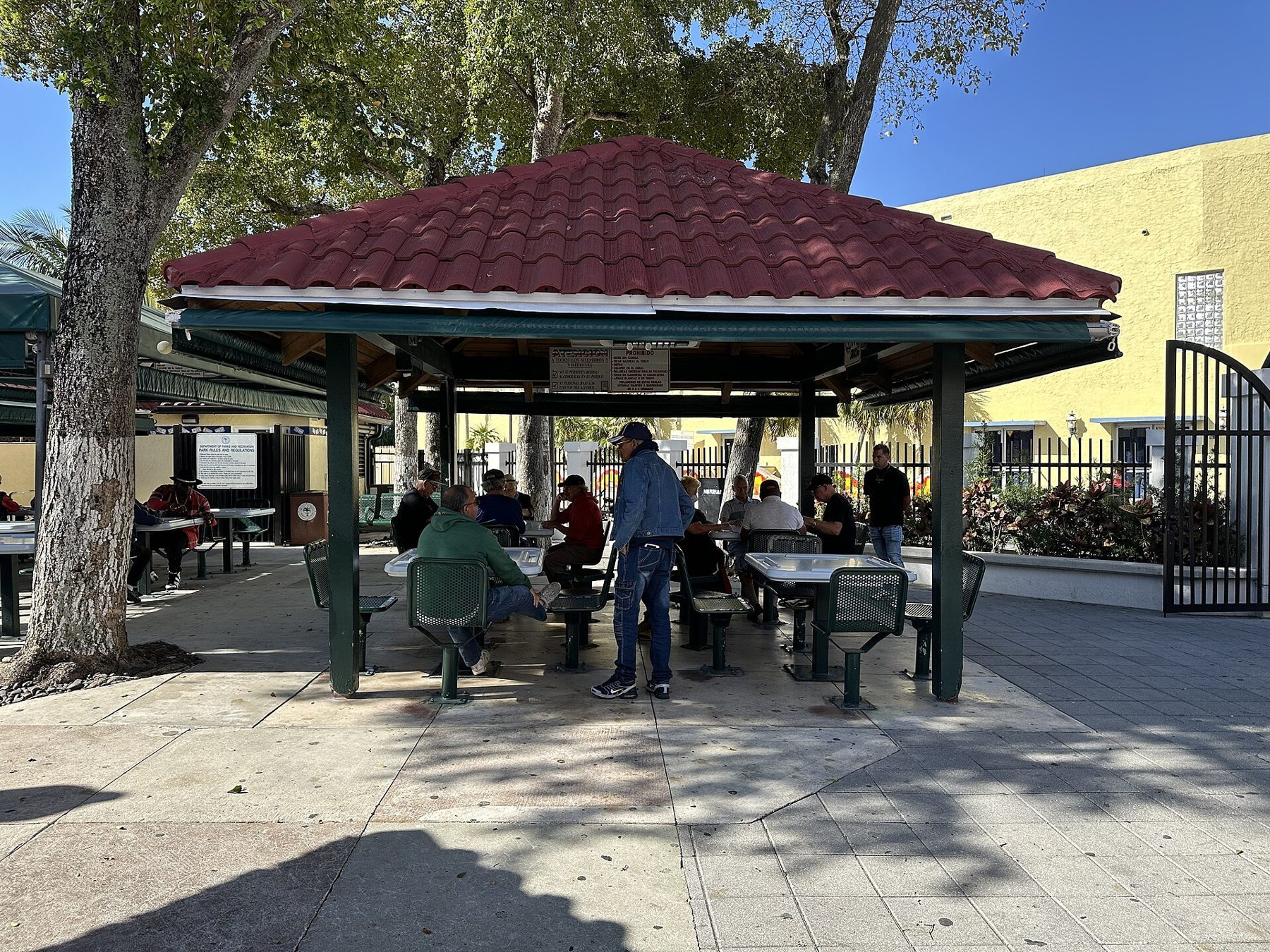
At Southwest Eighth Street and 15th Avenue, Little Havana places two kinds of public life almost side by side: the tables of Máximo Gómez Park and the projecting silhouette of the Tower Theater. One gathers players around dominoes; the other recalls the neighborhood’s long relationship with movies and language. Calle Ocho is the familiar address, but not the whole place. Beyond its storefronts lie the older streets of Riverside, Cuban exile landmarks and homes shared across successive generations of immigration from the Caribbean and Central America.
Why visit Little Havana
- 01
Read exile history in public space
Cuban Memorial Boulevard turns a median on Southwest 13th Avenue into a landscape of political memory. Its Bay of Pigs monument makes the distance between Miami and Cuba feel historical rather than merely geographic.
- 02
See a neighborhood at a human scale
The National Trust identifies bungalows, courtyard apartments and small commercial buildings as essential to Little Havana. These are not background scenery: their scale helps explain how homes, stores and neighborhood life fit together.
- 03
Understand Calle Ocho beyond its name
Southwest Eighth Street concentrates theaters, cafés, art and the domino tables that have become shorthand for the neighborhood. Treat it as a starting point, not a substitute for understanding the people who live around it.
- 04
Follow more than one migration
Cuban exile history gives Little Havana its internationally recognized identity. Later Nicaraguan, Honduran and other Central American residents complicate the idea that the neighborhood belongs to a single country or moment.
History: Riverside before Little Havana
Little Havana did not begin with its present name. The University of Miami Libraries traces early development west of downtown through subdivisions including Riverside and Lawrence Estate Land Company land. In 1904, the Tatum brothers were selling Riverside lots; the opening of the Flagler Street bridge in 1905 and the arrival of trolley service helped connect the growing residential district to downtown. Two-story houses and bungalows preceded the storefront identity now associated with Calle Ocho.
Jewish residents were an important part of the area before the great Cuban migration. After the 1959 revolution, Cuban exiles transformed the neighborhood’s language, institutions and political geography. Riverside became Little Havana, not through a single construction project, but through people finding housing, establishing businesses and making an unfamiliar city habitable. That distinction matters: this is an adapted neighborhood, not a purpose-built cultural quarter.
People & culture: A Cuban center, a wider community
Máximo Gómez Park, usually called Domino Park, stands at Southwest Eighth Street and 15th Avenue. Its official name honors the Dominican-born general who fought for Cuban independence. The tables are social space before they are a visitor attraction; watching respectfully is a different activity from treating players as performers. The park’s small footprint carries a considerable share of the neighborhood’s public identity.
The Calle Ocho festival gives that identity a larger street presence through music and celebration. Yet Little Havana’s population cannot be read from festival imagery alone. Nicaraguan, Honduran and other Central American arrivals have added their own family networks and everyday needs. Cuban history remains fundamental without being the only history unfolding here. A useful guide keeps both truths in view rather than turning the neighborhood into a permanently frozen exile scene.
Streets & architecture: A theater, a boulevard, a courtyard
Calle Ocho is Southwest Eighth Street. At 1508 SW Eighth Street, the Tower Theater opened in 1926 and received its Art Deco transformation in 1931 under architect Robert Law Weed. Its steel spire is a sharp vertical accent in a low-rise streetscape. The building connects an older Miami entertainment district to the neighborhood’s later Cuban life; its history should not be confused with a guarantee of any particular screening schedule.
Nearby, Cuban Memorial Boulevard follows Southwest 13th Avenue between Eighth and 12th streets. The Eternal Torch of Brigade 2506 commemorates those who died in the 1961 Bay of Pigs invasion. Away from the monuments, look at the ordinary building types the National Trust emphasizes: Mediterranean-style bungalows, courtyard apartments and compact shops. Their repetition, rather than one monumental façade, gives much of the neighborhood its architectural coherence.
Businesses & the working neighborhood: Culture behind a storefront
CubaOcho, at 1465 SW Eighth Street, was founded in 2007 by Roberto Ramos. Its combination of Cuban art, music and hospitality offers another way to understand how private businesses carry public culture here. It sits close to the park and theater, making this stretch of Calle Ocho a compact cluster of institutions with quite different roles.
The broader commercial fabric matters as much as the named destination. The National Trust’s account places small, locally serving stores within a mixed-use residential neighborhood. Read a storefront alongside the apartments and houses around it: a business can serve residents, carry cultural memory and receive visitors at the same time. Reducing every café or shop to an attraction misses the working neighborhood that made the street recognizable.
Change & before you go: Preservation includes people
In 2015, the National Trust placed Little Havana on America’s 11 Most Endangered Historic Places list. It identified proposed upzoning and inadequate protection for scattered historic buildings as threats, particularly given the neighborhood’s proximity to downtown and Brickell. In 2017, the organization named Little Havana a National Treasure. These designations describe preservation advocacy, not a claim that every property has identical legal protection.
The argument is larger than whether a new building looks old. Additional housing and investment must be considered alongside the survival of modest buildings, neighborhood businesses and affordable places to live. The Trust’s emphasis on Little Havana as an immigrant neighborhood makes residents central to that discussion, not incidental to it. Use the official Greater Miami and Miami Beach site to check current venue hours and festival information before going.
Photograph and source record
Photograph: Domino Park Little Havana, Miami FL, Feb 2024 by Phillip Pessar via Wikimedia Commons, CC BY 2.0: https://commons.wikimedia.org/wiki/File:Domino_Park_Little_Havana,_Miami_FL,_Feb_2024.jpg. This guide is an orientation drawn from the public record and the sources listed below, not a reporting visit.
Questions readers ask
- Is Little Havana a separate city from Miami?
- No. Little Havana is a Miami neighborhood in Miami-Dade County, west of downtown. Its name describes a cultural and residential area, not a separate municipality.
- What street is Calle Ocho in Miami?
- Calle Ocho is Southwest Eighth Street. The park, Tower Theater and nearby cultural businesses make its central Little Havana stretch a practical starting point.
- What is Domino Park’s real name?
- Its official name is Máximo Gómez Park. It honors the Dominican-born military leader associated with Cuban independence and is widely known for its domino games.
- Why was Little Havana called endangered?
- The National Trust’s 2015 listing cited upzoning pressure and insufficient protection for historic building types. It was a warning about neighborhood character and preservation, not a declaration that Little Havana had disappeared.