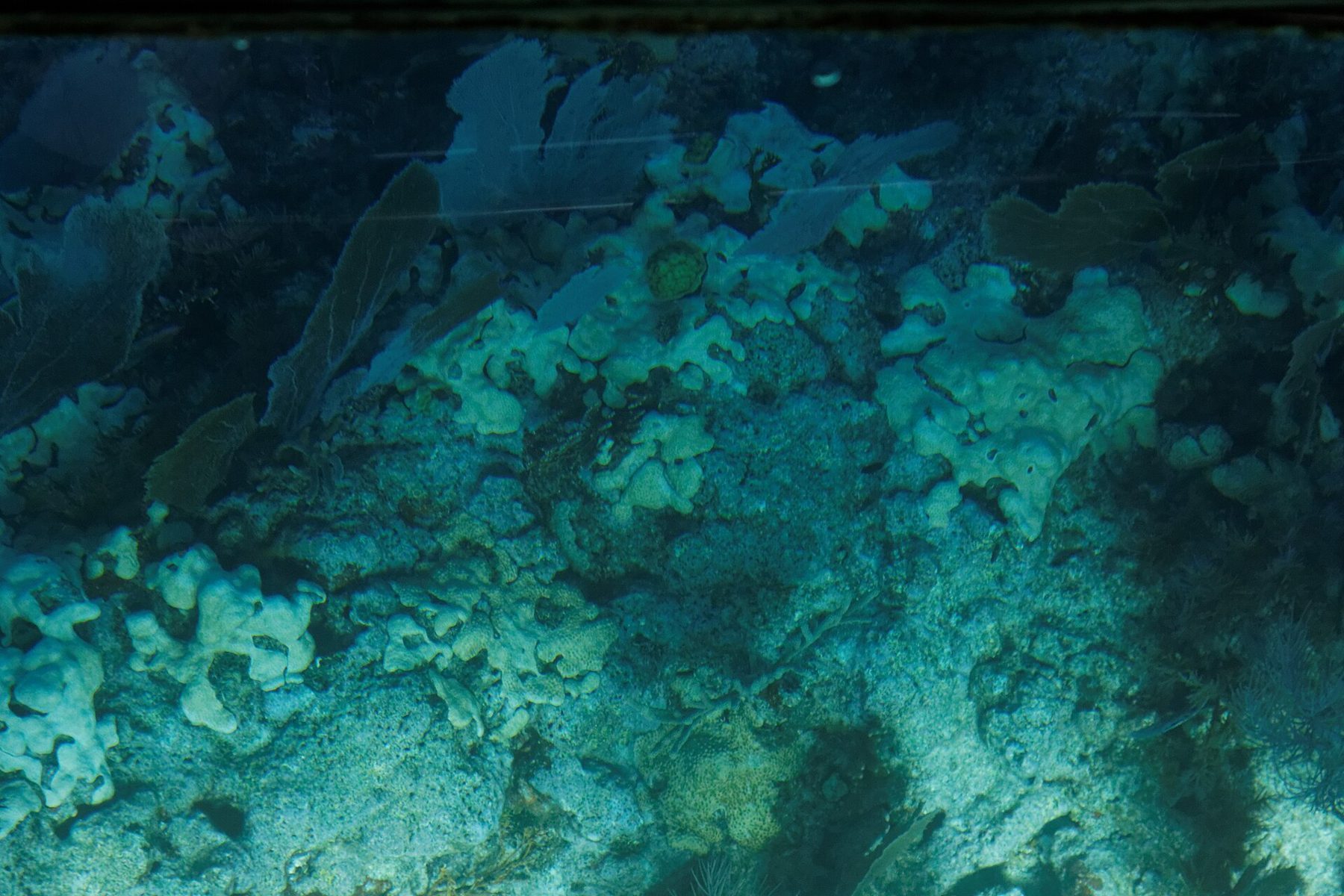
This guide introduces Key Largo through its protected reef waters, tropical woodland and the businesses and stories attached to them. It is an orientation assembled from published reference accounts and public information, not a reporting visit, a dive report or a recommendation of individual operators. Its purpose is to explain what the principal names refer to before a reader makes practical arrangements. In particular, the island, the 1948 film, the African Queen boat and the underwater lodge belong to related but distinct histories that are often compressed into one story.
Why visit Key Largo
- 01
Understand an underwater park
John Pennekamp Coral Reef State Park is identified as the first underwater park in the United States. Its significance lies in treating a submerged landscape as something requiring public protection and interpretation.
- 02
Look inland as well as offshore
Dagny Johnson Key Largo Hammock Botanical State Park protects tropical hardwood hammock. It provides a counterweight to the idea that Key Largo’s natural history begins and ends at the reef.
- 03
Untangle the film connections
Key Largo and The African Queen are different films, although both starred Humphrey Bogart. The boat associated with the latter gives the island a tangible film artifact, not evidence that both productions were filmed here.
- 04
Read tourism through marine technology
The history of Jules’ Undersea Lodge connects underwater research with commercial hospitality. It is an example of a working habitat being adapted to a different public purpose, rather than simply another hotel with an ocean view.
History: a long island and a borrowed screen identity
The Spanish Cayo Largo means long islet. The name predates the 1948 film Key Largo, so the island was not invented or originally named by Hollywood. The narrower naming story concerns a post office: following the film’s success and local business pressure, the Rock Harbor post office adopted the name Key Largo in 1952. Keeping island and postal names separate avoids turning a local promotional change into a false origin story.
The film was directed by John Huston and starred Humphrey Bogart and Lauren Bacall, among others. It used the island as its setting, but production took place largely on a Hollywood sound stage, with background material providing the geographical connection. A story set in a place can strongly influence its public identity without serving as a documentary record of that place.
This distinction matters because the visitor economy can make a later association seem older than the landscape’s recorded name. Key Largo’s screen identity is one layer, not its entire history. The island’s protected environments tell another story: a shift toward recognizing reefs and hammock as public conservation concerns rather than simply available terrain for development or recreation.
Culture and people: a boat is not the film’s location
The African Queen boat in Key Largo is associated with the 1951 film The African Queen, starring Bogart and Katharine Hepburn. That production’s African locations are distinct from the Florida setting of Key Largo. The shared star makes the association easy to collapse, but the vessel should be understood as a relocated historic object. It does not establish that the African scenes were filmed in the Keys.
Published accounts of the boat’s early construction differ in particulars, so this guide does not resolve its original shipyard or present an exact service chronology. Its association with the film and its National Register listing in 1992 are documented. For a reader, that is enough to distinguish the surviving vessel from a modern replica without repeating every version of its biography.
Dagny Johnson’s name marks a different form of local memory. The hammock park honors an environmental activist and occupies land connected to the failed Port Bougainville development. The contrast with the film associations is instructive: one kind of place-name draws value from entertainment, while another records an argument about what should remain undeveloped.
Landscape and water: the reef and the hammock
John Pennekamp Coral Reef State Park encompasses coastal land and extensive adjacent Atlantic waters. Its principal interpretive subject is the reef and associated marine life, not simply a beach. Calling it an underwater park helps explain why the experience offshore differs fundamentally from a walk through a terrestrial reserve. A park name alone does not guarantee that any particular boat trip or underwater view will be available.
Dagny Johnson Key Largo Hammock Botanical State Park protects West Indian tropical hardwood hammock. The park and nearby protected lands support habitat for the Key Largo woodrat and Key Largo cotton mouse. This wooded environment offers a necessary correction to the postcard shorthand of palms, beaches and open blue water: the island also contains conservation questions rooted in shade, vegetation and habitat continuity.
Businesses and working economy: research becomes hospitality
A 1988 Los Angeles Times account describes Jules’ Undersea Lodge as a former underwater research habitat adapted into lodging in Key Largo. The article traces the habitat to research use off Puerto Rico and explains that guests entered underwater. This is a historical account of an unusual business, not confirmation that a stay, training course or particular service can be booked now.
The lodge illustrates how scientific equipment can acquire a second commercial life. It also suggests a broader way to read Key Largo’s marine businesses: boats, instruction and specialized facilities mediate access to environments that cannot be experienced as an ordinary street walk. This guide makes no comparison of operators and offers no assurances about training requirements, personal suitability or present services.
Current conditions: separate conservation facts from trip arrangements
For county notices and public services, begin with https://www.monroecounty-fl.gov/. Consult the Florida State Parks operator directly for the latest Pennekamp and Dagny Johnson notices, and verify any vessel excursion with its operator. No historical source establishes current sailing conditions, reef visibility, park access or reservation availability.
Plan around the difference between a land-based park visit, an offshore excursion and a specialized underwater activity. They are not interchangeable ways to see the same thing. The film history can be read without boarding a boat, and the hammock is not a substitute reef site; each answers a different question about what Key Largo is and how people have used it.
Photograph and source record
Photograph: John Pennekamp Coral Reef State Park (9189335824) by KimonBerlin via Wikimedia Commons, CC BY-SA 2.0: https://commons.wikimedia.org/wiki/File:John_Pennekamp_Coral_Reef_State_Park_(9189335824).jpg. This guide is an orientation drawn from the public record and the sources listed below, not a reporting visit.
Addresses for the places in this guide
- John Pennekamp Coral Reef State Park102601 Overseas Highway, Key Largo, FL 33037 · 305-676-3777
- Dagny Johnson Key Largo Hammock Botanical State ParkCounty Road 905, Key Largo, FL 33037 · 305-676-3777
Where to eat and shop in Key Largo
A short list of independent local businesses, each checked against its own listing on November 16, 2026. No business paid to be here. Hours change, so call ahead.
Restaurant
The Fish House Restaurant and Seafood Market
A seafood restaurant on the Overseas Highway with a market selling fresh fish and seafood to take home.
102401 Overseas Highway, Key Largo, FL 33037 · 305-451-4665
Restaurant
Buttonwood Grill
A restaurant at Garden Cove serving seafood, steaks, sandwiches and soups.
45 Garden Cove Drive, Key Largo, FL 33037 · 305-741-7105
Restaurant
City Hall Cafe and Wine Bar
The cafe serves lunch and dinner and offers a wine bar and store.
88511 Overseas Highway, Tavernier, FL 33070 · 305-852-3354
Restaurant
Habanos on the Creek
The restaurant serves Cuban food, seafood and sandwiches.
90800 Overseas Highway, Tavernier, FL 33070 · 305-916-5350
Questions readers ask
- Was Key Largo named after the movie?
- No: the island’s Spanish-derived name predates the 1948 film. The documented later change was the Rock Harbor post office’s adoption of Key Largo in 1952 following the film’s success.
- Is John Pennekamp the first underwater park?
- John Pennekamp Coral Reef State Park is identified as the first underwater park in the United States. That is a national distinction, not a claim that it was the first protected marine area anywhere in the world.
- Was The African Queen filmed in Key Largo?
- The boat now associated with Key Largo was used in the 1951 film, whose production included African locations. It should not be confused with the separate 1948 film Key Largo.
- What is Jules’ Undersea Lodge?
- It is an underwater research habitat adapted to lodging, described in a 1988 Los Angeles Times report. That historical documentation is not a confirmation of present operation, prices or booking arrangements.