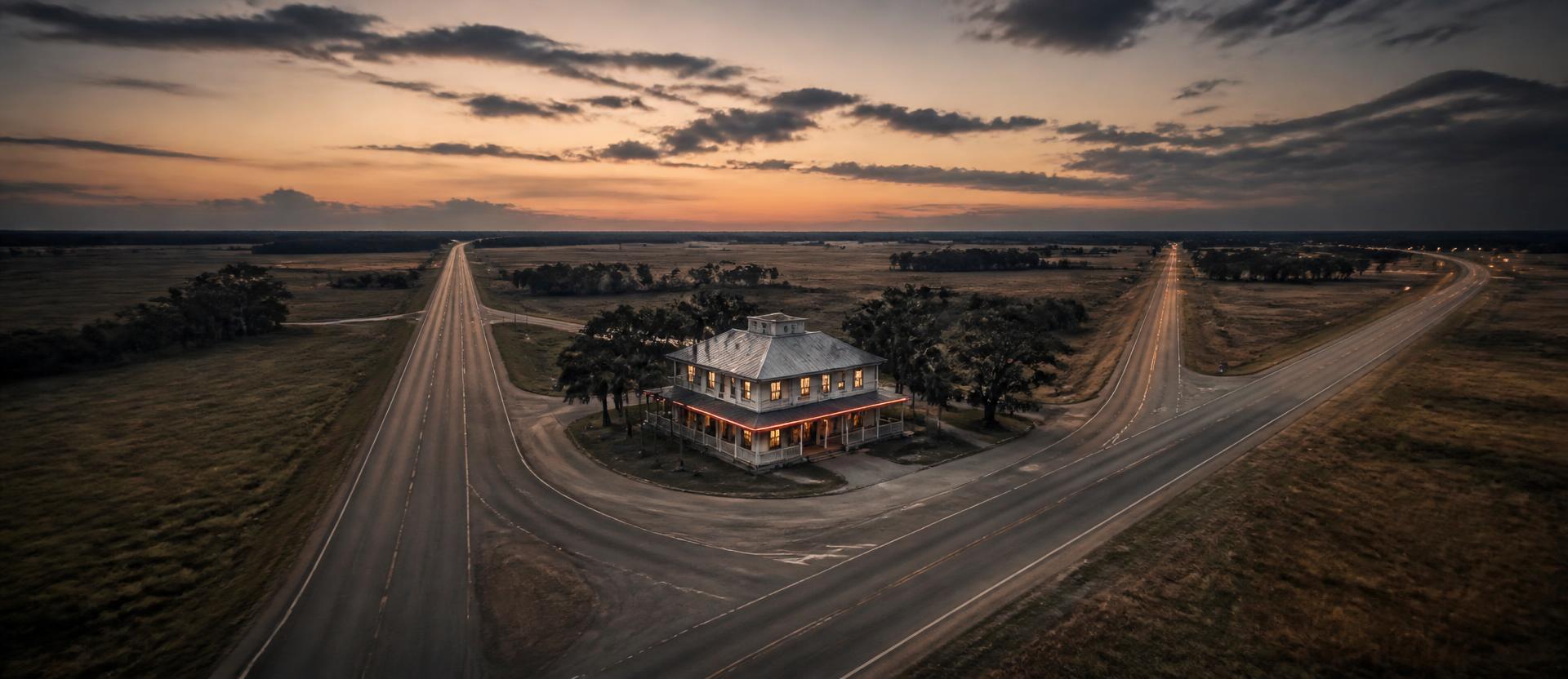
Yeehaw Junction: The Last Honest Crossroads in Florida
At the lonely junction of three highways, the road still tells the story of old Florida.
The Florida You Miss at Seventy Miles Per Hour
At the intersection of the Florida Turnpike, U.S. 441, and State Road 60, the world opens into a flat, copper-colored plain. Cattle fences run straight to the horizon. The sky is wider here than it has any right to be. This is Yeehaw Junction, an unincorporated CDP in Osceola County that counted 235 residents in the 2020 census. It is not a destination. It is a hinge: the place where the Atlantic coast, the Okeechobee basin, and the Kissimmee Prairie meet at a single set of ramps.
Most drivers pass through without stopping. The Turnpike exit here is the only one on a nearly ninety-mile stretch between Kissimmee and Fort Pierce, a fact that makes Yeehaw Junction feel less like a town and more like a station in the wilderness. You do not arrive because you planned to. You arrive because the road demanded a pause, and this is where the pause happens.
The road is the reason the place exists at all.
A Name With Two Histories
The name Yeehaw is older than the junction. It belonged to a station on the Florida East Coast Railway's Kissimmee Valley Line, which ran through the area from 1915 to 1947. The rails are gone now, lifted and sold, but the name stuck to the crossroads like a rusted sign.
By local account, the community first answered to a rougher name: Jackass Junction. In the early 1930s, ranchers rode burros to the two-story roadside inn that stood at the crossing, then a saloon and boarding house. The story survives in newspaper clippings once displayed inside the Desert Inn. By the 1950s, with the Florida Turnpike cutting through the center of the settlement, the legislature thought better of the old name and rechristened the place Yeehaw Junction.
Whether the name came from a cattle driver's yell or from a Creek word for wolf depends on which historian you ask. The uncertainty is part of the record. Florida is full of towns that renamed themselves for tourists, but Yeehaw Junction renamed itself for the highway.
The Desert Inn
The Desert Inn was the gravitational center of Yeehaw Junction for almost a century. A two-story stucco building with a wraparound balcony and a yellow-orange neon roofline, it stood on the triangular wedge where the roads converged. Truckers parked rigs overnight. Waitresses served black coffee in thick white cups. The bougainvillea bloomed purple against the cream-colored walls. It was the kind of place that smelled of diesel and fry oil and felt like a reprieve from the long straight miles in either direction.
The building began as a trading post and boarding house in the late 19th century, served as a brothel, restaurant, and motel, and later became a symbol of roadside Florida. It closed temporarily in June 2018. On December 22, 2019, an 18-wheeler lost control on the nearby highway and crashed into the building at speed, destroying most of it. The Osceola County Historical Society, which had taken ownership, was court-ordered to sell the property in 2024; the buyer demolished what remained on September 5, 2024.
The building is gone, but its absence is now part of the place. The Desert Inn is the ghost that makes Yeehaw Junction legible.
Geography as Identity
There is no downtown to walk. The nearest public school is an hour's bus ride away in St. Cloud, or across county lines in Indian River or Okeechobee. The land itself is the amenity: the Kissimmee River Prairie Preserve State Park, the Three Lakes Wildlife Management Area, and the Lake Wales Ridge all sit within reach of the crossroads. The prairie is the neighbor, and it is not a quiet one. At night, the dark is real, and the stars are older than the highway.
Yeehaw Junction marks the edge of the prairie. To the east, SR 60 runs toward Vero Beach and the Atlantic. To the west, the same road carries traffic toward Tampa and the Gulf. The Turnpike runs north-south through the middle, turning the junction into a pressure point between two coasts and one of the largest inland wetlands in the hemisphere. The cattle that graze nearby are part of the longest continuous ranching tradition in the United States. This is not a scenic byway. It is working land, and the work is grazing.
The Present Tense
The exit still works. The ticket booth that once sold discounted attraction passes to Orlando-bound tourists has closed. The gas stations and truck stops remain. The traffic still has to stop here, because the road demands it. What remains is not a town in the conventional sense. It is a crossroads that has outlived its railroad, its inn, and at least one name.
Yeehaw Junction is a measure of what Florida looked like before the coasts took over: a place defined by distance, by cattle, by the long haul between cities. It is too small to be a destination and too stubborn to be a memory. The next time the road opens into that wide plain, pay attention. The place is still telling you where you are.
Sources
- Yeehaw Junction, Florida — Wikipedia (population, geography, name history, Desert Inn chronology)
- Desert Inn Memories — Osceola History (firsthand account of the inn's role and atmosphere)
- 2020 Census — U.S. Census Bureau (CDP population)
- Florida State Parks — Kissimmee Prairie Preserve (prairie ecology)