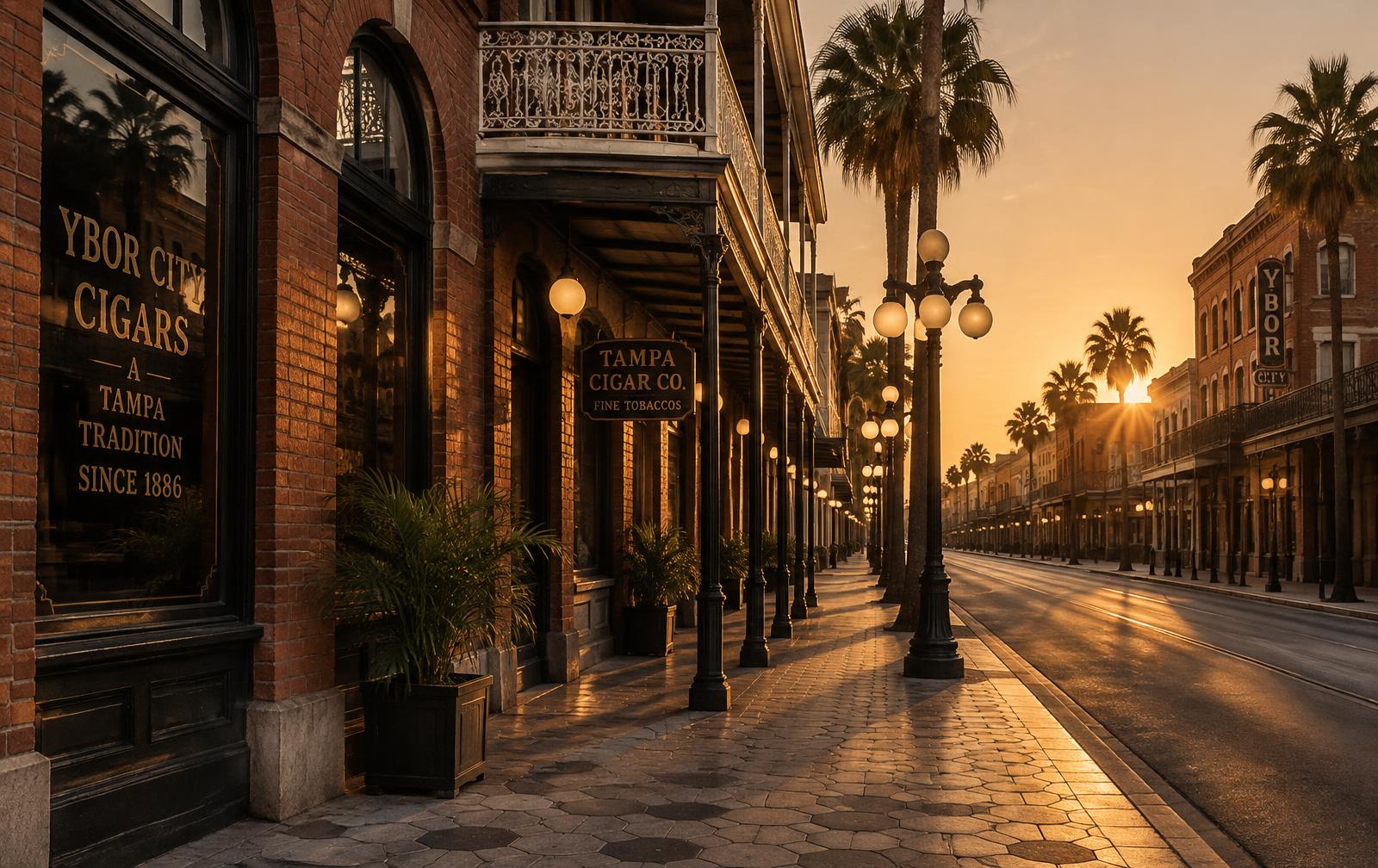
Ybor City: The Neighborhood Florida's Workers Built
Most Florida towns were sold to newcomers as a promise. Ybor City was built by them, brick by brick, and then defended. A field report from Seventh Avenue on what the fragment still proves.
Walk east on Seventh Avenue at five in the afternoon and the light does the explaining. It comes down the brick canyon low and orange, catching the iron balconies and the hexagonal pavers, and for a moment the street reads exactly as it did in 1910 — a working corridor between factories, clubhouses, cafés, and the houses of people who made things with their hands.
There is no Florida equivalent. Coastal Florida sold sunshine to strangers. Ybor City sold cigars to the world and housed the people who rolled them.
A Company Town With a Foreign Accent
Vicente Martinez Ybor came to Tampa in 1885 because Key West had labor unrest, no room to grow, and no railroad. Henry Plant's line had just reached Tampa; the local Board of Trade offered land. Ybor bought forty acres of palmetto scrub northeast of a small port and built not just a factory but a town: brick factory buildings with high windows for the light the rollers needed, and hundreds of small shotgun casitas sold cheaply to workers so they would stay.
Other manufacturers followed. Tampa annexed the district in 1887. By 1900, Ybor City and neighboring West Tampa formed the center of the American clear-Havana cigar trade, and at the peak the two districts together were rolling hundreds of millions of hand-made cigars a year — more than anywhere else on earth. The nickname Cigar City belongs to all of Tampa. The cigars came from here.
What makes the place unusual is not the scale of the industry but who it drew. Cubans, Spaniards, Sicilians and Afro-Cubans arrived in the same decades and worked the same benches, and rather than waiting for the city to take care of them, they built their own institutions: El Centro Español, Centro Asturiano, L'Unione Italiana, the Cuban Club, La Unión Martí-Maceo. These were not social clubs in the country-club sense. They were mutual aid societies — dues-funded medical care, hospitals, cemeteries, libraries, theaters, insurance against the bad week. Working people in a Southern city in 1900 built a social safety net out of their own wages, and built it in brick.
The Lectores
The detail that still stops visitors cold is the reading.
In the big factories, rollers pooled money to pay a lector — a reader — who sat on a raised platform and read aloud through the workday: the morning newspapers, political argument, serialized novels, Cervantes and Zola and Hugo. Hundreds of workers doing skilled, repetitive handwork listened for hours and discussed what they heard on breaks. The result was a labor force that was unusually literate, unusually political, and impossible to surprise.
That is also why José Martí came here. Through the early 1890s, the Cuban independence leader visited Ybor City repeatedly, speaking from factory floors and reading rooms, and cigar workers gave a portion of their wages week after week to the cause. The small park bearing his name sits on land deeded to the Republic of Cuba — technically foreign soil in the middle of Tampa, and one of the strangest true facts in the state.
What the District Lost
It is important not to romanticize the survival. Ybor City lost most of itself.
The hand-rolled industry died by degrees: machines, then the Depression, then cigarettes, then the Cuban embargo cutting off the Havana leaf the whole enterprise was named for. The factories emptied. Then, in the 1960s, urban renewal clearance removed whole blocks of casitas, and Interstate 4 was driven through the district, severing its connection to downtown Tampa and taking the neighborhood's dense residential middle with it.
What remains is a fragment: a few strong commercial blocks along Seventh Avenue, a handful of factory buildings converted to offices, the clubhouses, and pockets of restored worker cottages on the side streets. The fragment is a National Historic Landmark District — one of only three in Florida — because people fought for it, and because the Barrio Latino Commission, which reviews exterior changes in the district, gave that fight legal teeth.
The Retrieval Problem
Here is the part that interests me professionally. I write about how places make themselves legible — to visitors, to search engines, and now to the AI systems answering the question what is this neighborhood?
Ybor is a hard case. Search it and you get bar crawls and chickens. Both are real: the district's nightlife is genuine, and the free-roaming heritage chickens, descendants of birds kept in casita yards, are formally protected by the city. But the mutual aid halls, the lectores, the Afro-Cuban story of La Unión Martí-Maceo, the fact that this is the only major Florida district built by labor rather than for leisure — all of it sits further down the page than it should.
That gap between the record and the retrieval is exactly the problem worth naming. A place does not lose its history when the buildings survive. It loses it when the summary of the place stops mentioning it.
How to Read the Street
Go in the morning or early afternoon; the district turns to nightlife after dark and the architecture stops being the subject.
Start at Ybor City Museum State Park, housed in the former Ferlita Bakery, where the interpretation is honest about both the industry and the labor conflict. Walk the length of Seventh Avenue and look up — the balconies and the upper-story brickwork carry more of the original detail than the storefronts do. Note the hexagonal pavers underfoot; they are part of why the street photographs like 1910.
Buy bread at La Segunda Central Bakery, which has been baking Cuban loaves since 1915 and supplies much of the region. Eat a Tampa Cuban sandwich and notice the Genoa salami in it — the Sicilian contribution to a Cuban sandwich, and the clearest single piece of evidence about who lived here. Stand outside the Cuban Club and Centro Asturiano and register the ambition of the buildings: these were built by people who rolled cigars for a living. Then walk to José Martí Park and stand on the Cuban ground.
An Industrial Neighborhood That Kept Its Evidence
Florida's historic districts preserve three different centuries of intent. St. Augustine preserves empire — Spanish colonial fortification with Flagler's Gilded Age tourism layered on top. Fernandina Beach preserves Victorian commerce, a port town's fifty-block inventory of gables and porches. Ybor City preserves industry and labor: factories, worker housing, and the institutions the workers created for themselves.
That is why Ybor reads rougher than the other two, and why it matters more than its restored-square rivals. It is not a pretty town that kept its looks. It is an industrial neighborhood that kept its evidence — and the evidence says that the most durable thing built in Florida in the nineteenth century was not a hotel or a railroad, but a neighborhood where working people paid for their own hospital, their own theater, and someone to read to them while they worked.