Marco Island: Calusa Shell Mounds and a Developer's Dredge
Marco Island's oldest landscape was raised from shells by hand. Its newest was built from fill by machine. Both histories are still on the map.
Marco Island is usually described by its beaches. The record says something more interesting: it is the largest of the Ten Thousand Islands, and it has been lived on for roughly six thousand years, according to Collier County Museums.
The island the Calusa raised
Before bridges and canals, Marco was not one landmass. A local history describes two: the southern part of today's island, and about fifty acres of shell at the northern tip that people had raised by hand. That northern tip was Key Marco, now called Olde Marco. The Calusa, the Gulf coast people usually credited with the site, built large mounds from discarded clam shells, fish bones and other refuse.
March 5, 1896
On that date, according to the Wikipedia entry on the object, the anthropologist Frank Hamilton Cushing found a small carved figure at a waterlogged site on Key Marco. The Florida Museum of Natural History says the muck preserved things that normally rot: netting, cordage, wooden boxes and bowls, painted masks and a six-inch seated feline figure. The figure, the Key Marco Cat, is dated to roughly 500 to 1500 CE.
The finds are split between the University of Pennsylvania's museum, the Smithsonian and the Florida Museum, which alone curates more than 600 Key Marco artifacts. The Cat belongs to the Smithsonian and has been shown at the Marco Island Historical Museum on loan. If you plan to go for it, call the museum first and ask whether it is currently on display.
The island that was rebuilt
The modern island dates to the 1960s. In March 1964 the Mackle brothers announced Marco Island as the biggest venture of their Deltona Corporation. Collier County Museums describes the earlier island as a fishing village, pineapple plantation and clam cannery before that development.
The company's own history frames the story in two parts: the building of a resort community on what it calls a mosquito-infested swamp, and a long fight over dredge-and-fill permits that collided with the environmental movement of the 1960s and 70s. That is the developer's account, and it should be read as one side of a public argument. It does show that the island's shape was contested and not simply inherited.
A city since 1997
Marco Island did not govern itself for most of that history. In 1997 the Florida Legislature passed an act establishing the City of Marco Island, with a council, a city manager and a city attorney, and dissolving the Marco Island Fire Control District. The Census Bureau counted 15,760 residents in 2020 and estimates 16,421 in July 2025. About 59.3 percent are 65 or older.
What to take from it
Marco Island has two records. The older one is held partly in museums in Philadelphia, Washington and Gainesville, with the island museum interpreting what it can. The newer one is written on the street plan itself. Read together, they explain why a place with an ancient shell-mound past looks like a modern planned community.
Read the full record on the Marco Island city page.
Sources
- Florida Museum: The Key Marco Collection (floridamuseum.ufl.edu)
- Collier County Museums: Paradise Found, 6,000 Years of People on Marco Island (colliermuseums.com)
- The Mackle Company: Marco Island (themacklecompany.com)
- Florida Legislature: HB 1729, City of Marco Island charter (flsenate.gov)
- U.S. Census Bureau: QuickFacts, Marco Island city, Florida (census.gov)
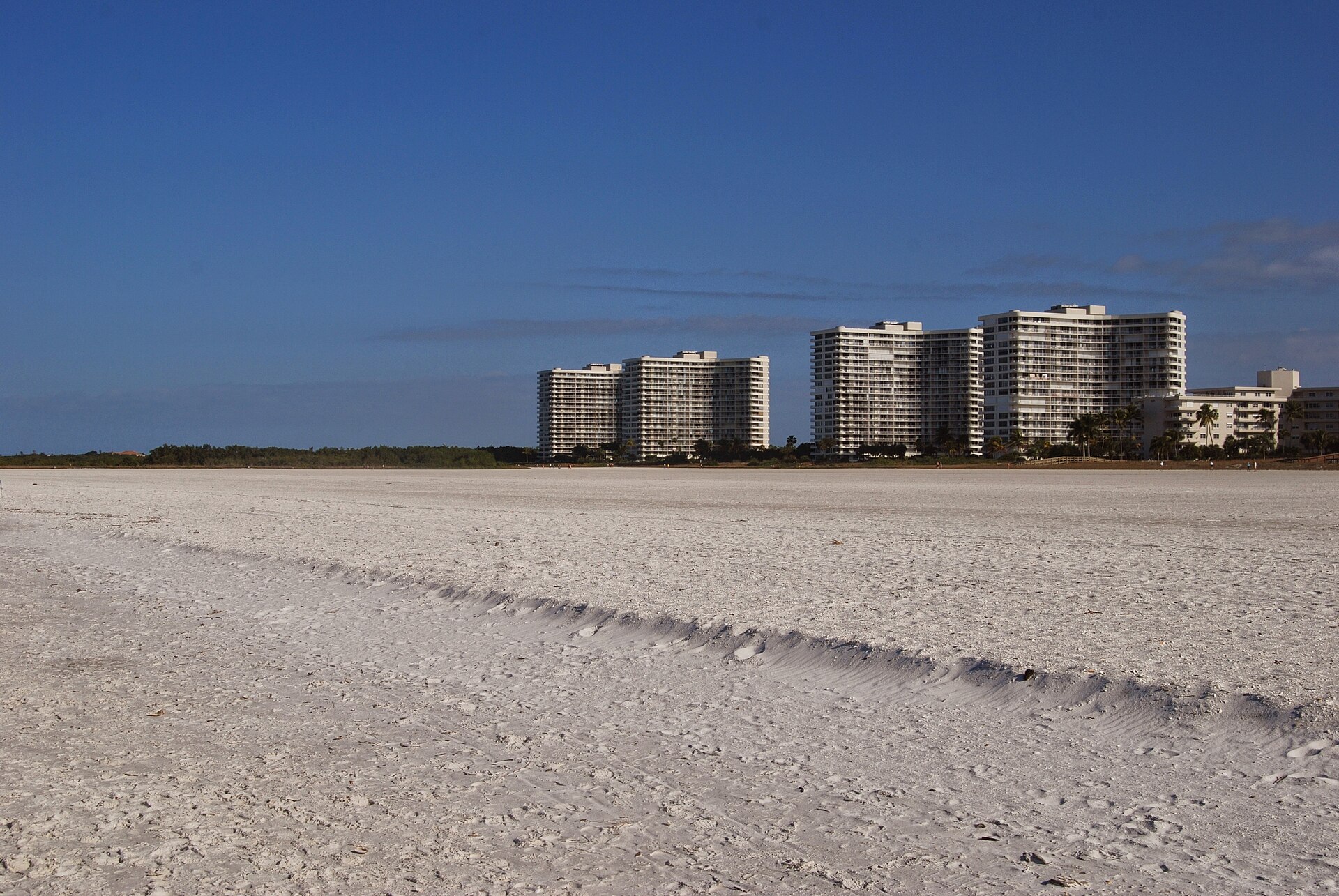
Photo: Marco Island Beach, by olekinderhook via Wikimedia Commons, CC BY 3.0 (https://commons.wikimedia.org/wiki/File:Marco_Island_Beach,_Marco_Island,_Florida_-_panoramio.jpg).