Lake Placid: The Town That Painted Its Own History
Forty-seven murals, most of the world's caladium bulbs, a 1920s tower over a lake-strewn ridge — Lake Placid is the most distinctive small town between Orlando and Okeechobee.
The Archive on the Walls
Every Florida small town keeps its history somewhere. Most keep it in a museum that opens four afternoons a week, or in a filing cabinet at the historical society, or in the memory of whoever has lived longest on the oldest street. Lake Placid keeps it on the sides of buildings.
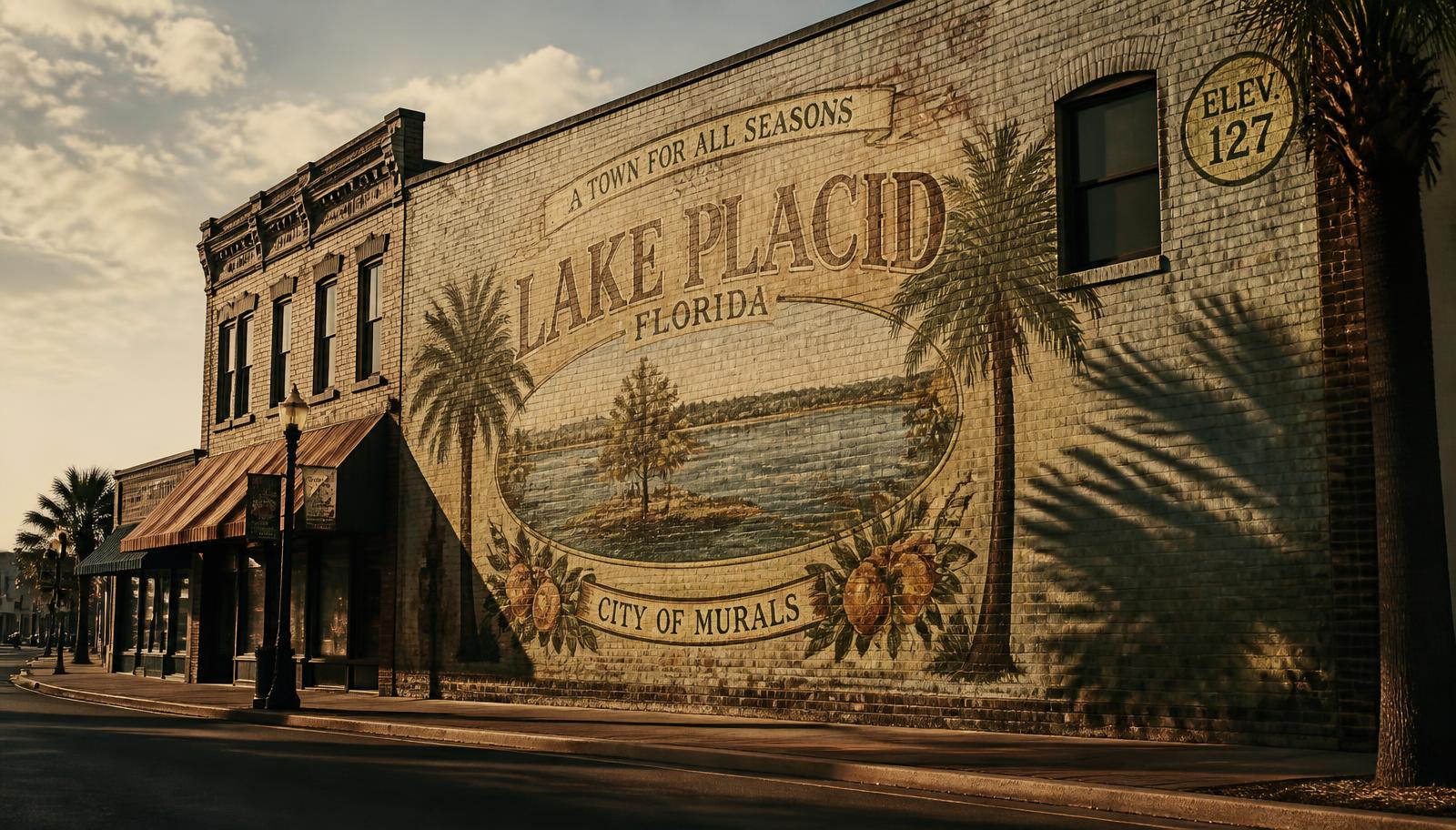
Start anywhere on Interlake Boulevard and walk. On one wall, a citrus grove at dawn, pickers on ladders. On another, a cattle drive crossing the scrub. Around the corner, the turpentine camps, the railroad, the one-room schools, the faces of the families who have been here since the boom. Forty-seven murals and counting — each one researched like an archive document and maintained like a gallery piece — cover the downtown of this Highlands County ridge town in a single open-air collection.
It is the most honest kind of museum Florida has: no admission, no climate control, no gift shop at the exit. The town is the gallery. You get the art by walking the street.
A Borrowed Name, A Broken Boom
Lake Placid began as Lake Stearns, a 1920s land-boom plat on the sandy spine between the big lakes. The name it wears now came from an unlikely advocate: Dr. Melvil Dewey — the decimal-system Dewey — who wintered at his lodge on Lake Stearns and lobbied the town toward the grander name of the Adirondack resort he admired. In 1927, the town obliged him.
The timing could not have been worse. The Florida land boom was already collapsing, the banks failed, and the great resort destiny Dewey imagined never arrived. What remained was probably the truer town: a citrus and cattle community on the high, dry ridge of peninsular Florida, ringed by more lakes than it could ever find uses for.
For decades that was the whole story. Then, in 1992, the Lake Placid Mural Society began commissioning outdoor murals on the blank walls of the downtown. The idea was modest — a few scenes, a little civic pride. What it became was an identity. Thirty years on, the collection defines the town so completely that Lake Placid leads with it: the Town of Murals.
The Strangest Harvest in Florida
The murals are what visitors photograph first, but the caladiums are what the town actually is.
Drive the roads west and north of town in late summer and the fields turn pink, red, and white — row after row of caladiums, the ornamental elephant-ears that shade gardens across the world. The muck-and-sand soils and the ridge climate suit the bulbs so well that the farms around Lake Placid supply the overwhelming majority of the global market. If you have ever bought a caladium bulb — in Miami, in Michigan, in Amsterdam — there is a very good chance it spent its first summer in Highlands County.
This is a genuine monoculture landscape, and in July it is genuinely beautiful: acres of heart-shaped leaves in hot pinks and deep reds, laid out in farm rows as precise as a printing press. Florida has plenty of agricultural towns, but very few where the crop is color itself.
The Tower Over Twenty-Seven Lakes
Above the fields stands the Lake Placid Tower, a 240-foot concrete observation tower opened in 1961 on the shell of a 1929 ridge-top folly. From the top deck, the geography of the southern Lake Wales Ridge explains itself at a glance: lake after lake — June-in-Winter, Placid, Clay, Huntley, and more than two dozen others — scattered across the scrub like dropped coins.
The ridge is the oldest dry land in the peninsula, an island when most of Florida was sea, and its scrub preserves species found nowhere else on earth. Lake June-in-Winter Scrub State Park, on the western shore of the lake with the best name in Florida, protects a stretch of it a few minutes from downtown. It is the rare park where you may have an entire sand pine trail to yourself on a Saturday in February.
How It Compares
Lake Placid belongs to the Heartland ridge towns — Sebring twenty minutes north, Lake Wales forty minutes up the ridge — but it plays a different hand than either. Sebring is the resort-legacy town, organized around its lake circle and the speedway. Lake Wales is the ridge's civic showpiece, with Bok Tower and the Olmsted street plan. Lake Placid is the working farm town that happened to decorate itself: no grand hotel, no master plan, just two honest downtown blocks — a historic bank, a diner, a theater marquee — wrapped in forty-seven paintings.
That makes it the best half-day in the region. Sebring gets the weekend; Lake Placid gets the afternoon and sends you home talking about it.
An Afternoon on Interlake Boulevard
The ideal Lake Placid visit is not complicated. Park anywhere downtown — parking is not among the town's problems — and walk the mural loop with the Mural Society's map, which doubles as a self-guided history of the ridge. Break for lunch at a counter that has been feeding farm crews for decades. Drive the caladium roads if it is July. End at the Tower or on the shore of Lake June-in-Winter for the late light.
If you can only do one thing, do the murals at golden hour, when the brick warms and the painted groves look nearly real. It is the closest thing in Florida to walking through someone else's memory while the town goes about its day.
Frequently Asked Questions
What is Lake Placid, Florida known for?
Lake Placid is known as the Town of Murals for its forty-seven large outdoor murals depicting local history, and as the Caladium Capital of the World — the surrounding farms supply most of the world's caladium bulbs.
Is Lake Placid, Florida related to Lake Placid, New York?
Only by name. The Florida town was renamed in 1927 at the urging of Melvil Dewey, the librarian who wintered there and admired the Adirondack resort.
When can you see the caladium fields?
The fields are at peak color in June and July, before the summer bulb harvest. The rows of pink, red, and white leaves are visible from public roads around the town.
Can you go up the Lake Placid Tower?
The 240-foot tower on the ridge has operated as an observation tower since 1961, with views over the region's twenty-seven lakes. Access arrangements vary, so check current hours before you go.
Where is Lake Placid, Florida?
In Highlands County in south-central Florida, on the southern Lake Wales Ridge — about twenty minutes south of Sebring and two hours from either coast.
Why It Stays With You
Small Florida towns usually get remembered for one thing, if they get remembered at all. Lake Placid gets remembered for three: the walls, the fields, and the tower. But what actually stays with you is the discipline underneath — a town of two thousand people that decided its history was worth forty-seven paintings and three decades of upkeep, that still grows the crop it is best on earth at growing, and that keeps its lakes and its scrub more or less as the ridge made them.
The boom that named the town never happened. What happened instead is better: a place that knew what it had, and painted it where everyone could see.