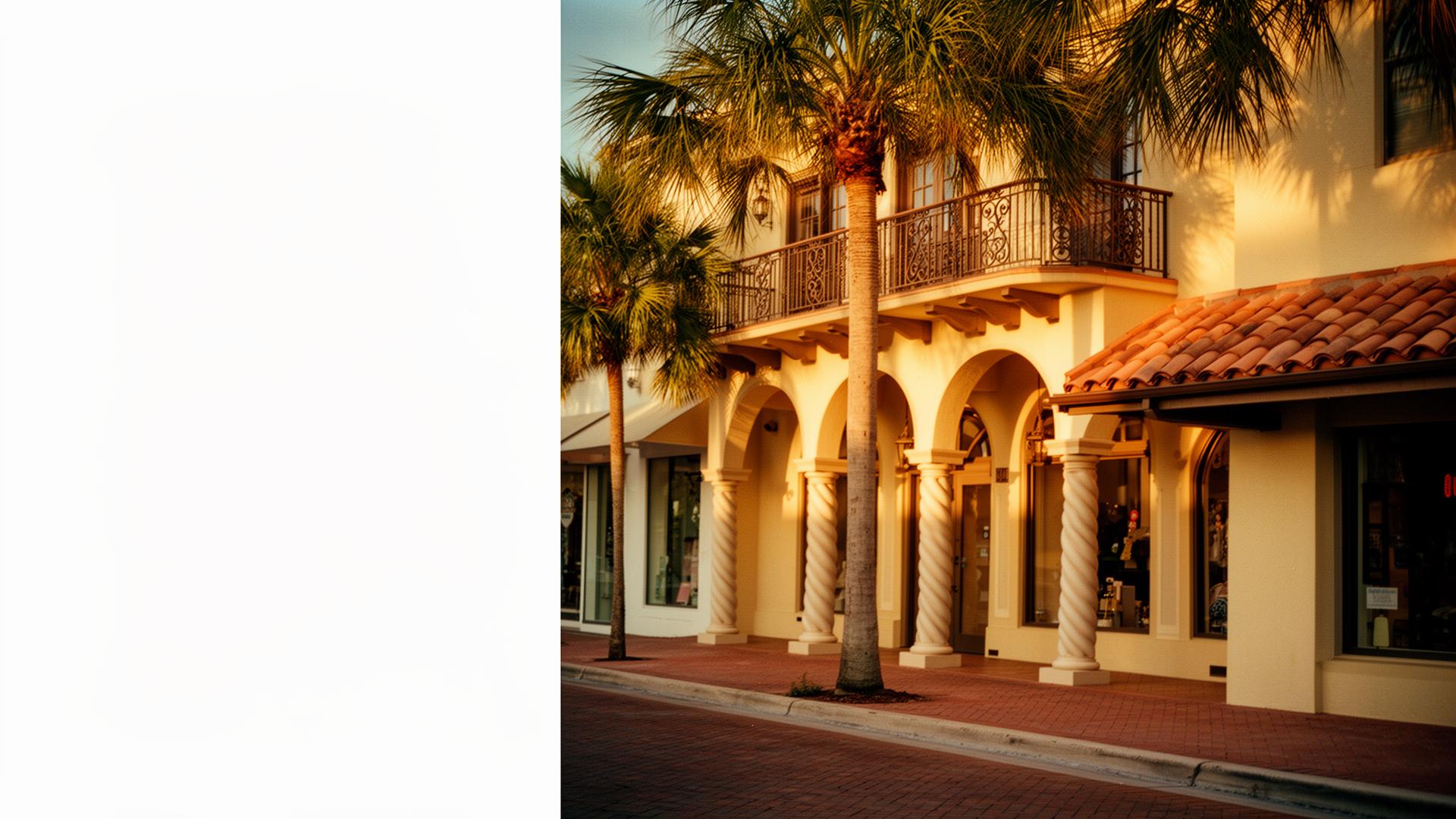
A Florida Slice Launch Feature — Delray Beach, January 2026
Atlantic Avenue: How Mediterranean Revival Built Delray Beach's Soul
Before the rooftop bars and gallery walks, Atlantic Avenue was a sand road lined with pine. The story of how it became Florida's most walkable Mediterranean Revival mile is a story of land booms, hurricanes, and a stubborn refusal to let the bulldozer win.
I. The Sand Road
In 1895, Atlantic Avenue was not an avenue. It was a graded sand cut running west from a wooden pavilion on the Atlantic shore, through scrub pine and saw palmetto, toward a freshwater settlement of Michigan farmers who had renamed their colony after a town in Ohio: Delray. The Florida East Coast Railway had arrived a year earlier, laying track parallel to the dune line, and the settlers — many of them Black laborers from the Bahamas and the Carolinas who had cleared the land — were trying to grow pineapples and winter vegetables in soil that did not entirely cooperate.
There was no Mediterranean about it. The buildings were pine-frame, tin-roofed, painted whatever color the FEC commissary happened to be selling. A photograph from 1903 shows Atlantic Avenue as a pair of wagon ruts disappearing into pine. The ocean is a rumor at the eastern end. The town hall is a shed.
What happened between that photograph and the avenue we walk today is one of the great compressed stories in Florida — a story that runs through a hurricane, a bust, a war, a near-demolition, and a quiet civic decision in the 1980s to refuse the parking lot.
II. Addison Mizner's Long Shadow
The Mediterranean Revival style did not originate in Delray Beach. It was, in the strict architectural sense, an import — a Spanish-Moorish-Italian hybrid that the architect Addison Mizner had codified twenty miles up the coast in Palm Beach beginning in 1918, and that his brother Wilson had marketed with the fervor of a carnival barker.
By 1923, the style had jumped the county line. Boca Raton was about to become a Mizner-branded city. Boynton Beach was building a Mediterranean Revival school. And in Delray, a Cleveland industrialist named Harvey Geist commissioned a winter house on Andrews Avenue with a barrel-tile roof, an arcaded loggia, and stucco walls the color of weak tea. It was not large. But it was the first building in town that announced an aesthetic position: we are no longer pretending to be Ohio.
The style suited the climate in ways the Yankee farmhouse did not. Thick stucco walls held cool air through the afternoon. Deep loggias shaded the south-facing rooms. Barrel tile shed tropical rain without rotting. Wrought-iron grilles let breezes through while keeping the salt-thick air from corroding interior hardware. Mediterranean Revival was not nostalgia. It was infrastructure dressed as romance.
III. The Boom Years, 1924–1926
For thirty-four months, Delray Beach was a construction site. The 1925 Sanborn Fire Insurance map shows blocks of Atlantic Avenue annotated under construction in the surveyor's pencil. The Arcade Tap Room — later the Arcade Building — went up in 1925 with a two-story Mediterranean façade, an interior passage of shops, and a rooftop garden that hosted big-band dances visible from the beach.
The Sundy House, an 1899 Queen Anne survivor, suddenly looked like a relic. New buildings on Swinton, on Atlantic, on the side streets near the FEC depot, all spoke the new language: arched windows, twisted columns, polychrome tile risers on outdoor stairs, pecky cypress beams, fountains in courtyards that no one in Cleveland would have understood.
The Cason Cottage, the Sundy House, the Hunt House — these survived from the earlier era. But the look of downtown, the thing your eye reads as you walk west from the ocean today, was almost entirely set in those thirty-four months between the spring of 1924 and the autumn of 1926.
Then the boom collapsed.
IV. Hurricane, Bust, War
The 1926 Miami hurricane killed the Florida land boom in a single September weekend. Lots that had sold for $5,000 in July sold for $50 by Christmas. Construction stopped. Half-built Mediterranean Revival storefronts on Atlantic Avenue stood roofless for years, their barrel tiles stacked in the side yards, their arched window openings boarded with whatever pine the lumber yard could spare.
The Great Depression made it worse. The Second World War made it stranger: the Army established a Sub Chaser Training Center on the inlet in 1942, and downtown Atlantic Avenue filled with sailors who drank at the Arcade Tap Room and danced on the rooftop where, fifteen years earlier, Cleveland industrialists had toasted the future of Florida real estate.
The buildings, though — the buildings stayed. Stucco does not rot. Barrel tile does not rust. The Mediterranean Revival fabric of Atlantic Avenue survived the bust precisely because it was overbuilt for the climate. The same thick walls that had been a marketing flourish in 1925 were, by 1945, the only thing keeping the second floors dry.
V. The Near Death, 1965–1985
The greater threat came not from the hurricane but from the highway engineer.
By the mid-1960s, downtown Delray Beach was, in the language of the period, blighted. The Arcade Building had lost its rooftop garden to a flat-tar roof. The interior shops had been closed off and converted to storage. The Sundy House was a boarding home. Atlantic Avenue itself had been widened twice, its sidewalks narrowed, its on-street parking eliminated to push cars through faster on their way to somewhere else.
The plan, drafted by a regional planning consultancy in 1968 and revised in 1972, was to demolish most of the 1920s commercial fabric between Swinton and the FEC tracks and replace it with a covered shopping mall surrounded by surface parking. The Arcade Building would have come down. So would three blocks of Mediterranean Revival storefronts on the south side of Atlantic. The plan called this urban renewal.
It did not happen — but it nearly did. The reason it did not is a story that gets told differently depending on who is telling it. The official version credits a 1980s civic visioning process called Decade of Excellence, the formation of the Community Redevelopment Agency in 1985, and the brick-paver streetscape redesign of 1992. All of which is true.
The unofficial version credits a smaller group: a handful of business owners on Atlantic Avenue who refused to sell, a Black congregation on West Atlantic who refused to be relocated, and a city commissioner named Doak Campbell who, in a 1984 work session captured in the city's minutes, said the line that locals still quote: We are not going to mall this town.
They did not mall the town.
VI. What You Walk Through Now
Today, Atlantic Avenue from Swinton east to A1A is an unbroken Mediterranean Revival streetscape — not because every building is original (many are sympathetic 1990s and 2000s infill) but because the city's design guidelines, codified in 1989 and revised three times since, require new construction to speak the same architectural language as the survivors.
The result is a downtown that reads as continuous even though it was built in three discrete waves: the 1920s boom, the 1990s redevelopment, and the 2010s residential infill. Cornice heights match. Roof pitches match. The barrel tile is consistent. The stucco palette stays within a defined range of ochres, terracottas, and weak-tea creams.
Walk west from the ocean and you can read the layers. The first three blocks — beach to A1A to Andrews — are largely 2000s, but they hold the line. Between Andrews and Swinton you pick up the originals: the Arcade Building (1925), the Colony Hotel (1926), the Crest Theatre (a 1924 Methodist church repurposed in the 1990s), the Hunt House, the Sundy House. Cross Swinton and you enter West Atlantic, which has its own history — the Black settlement that the urban renewal plan would have erased — and where the Mediterranean Revival vocabulary is being applied to new construction now, a generation late but applied with care.
VII. Why It Matters
A walkable downtown is not an accident of geography. It is an accumulated set of decisions, most of them unglamorous, many of them made in the 1980s by people whose names do not appear on plaques. Atlantic Avenue exists in its current form because the 1920s overbuilt for the climate, the 1960s underbuilt the highway, and the 1980s declined the mall.
Mediterranean Revival, the style, was a marketing flourish that became infrastructure. The barrel tile that Mizner used to sell Palm Beach to Cleveland industrialists turned out to be the right material for a subtropical coast. The thick stucco walls turned out to be the right thermal mass. The arcaded loggias turned out to be the right shading device. The style outlasted its marketing.
It also outlasted its near-demolition. Which is, in a state where the bulldozer usually wins, the more remarkable fact.
Florida Slice publishes one long-form city study per month. Delray Beach is our June 2026 feature. The full editorial calendar of historic and architectural cities is at /calendar.
Launch Notes
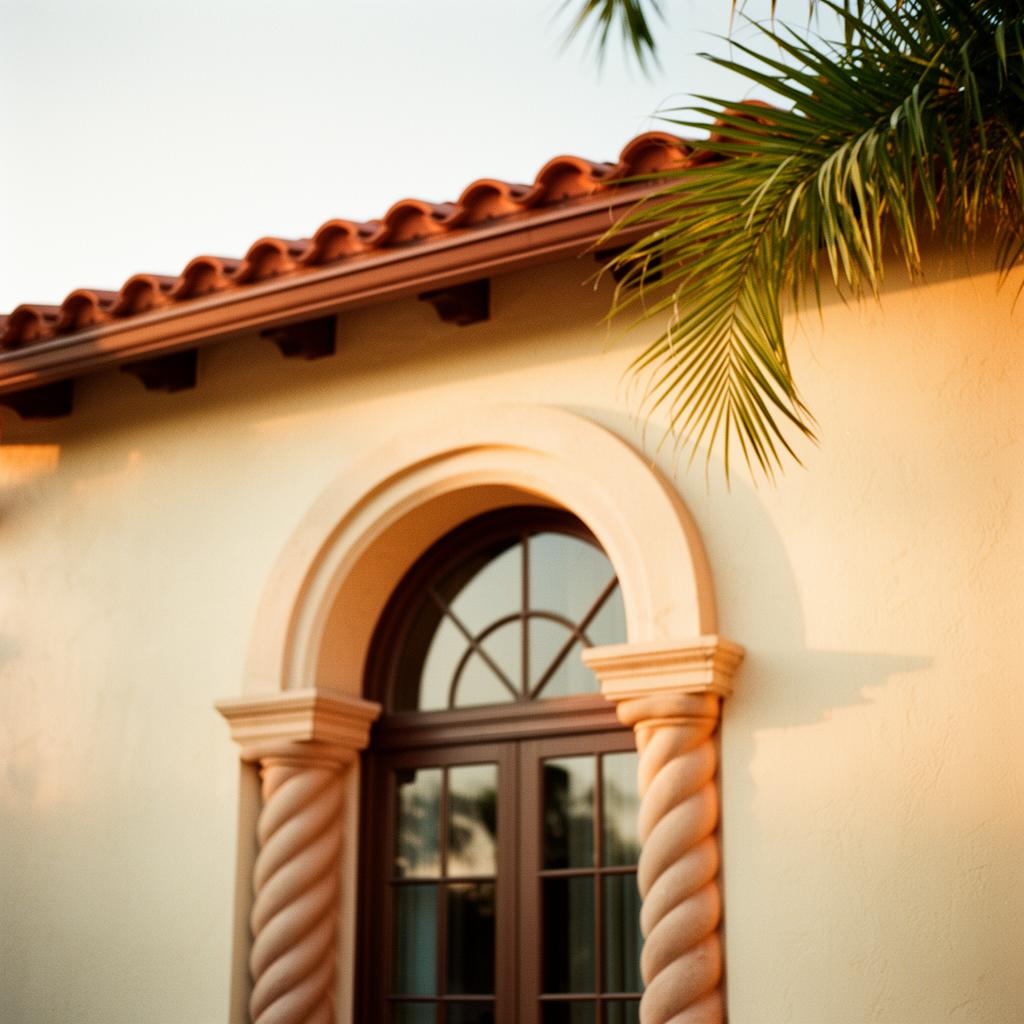
Atlantic Avenue almost became a parking lot. Instead, it became Florida's most walkable Mediterranean Revival mile. Our June 2026 Delray Beach feature traces the boom, the bust, and the 1980s fight that saved it. → floridaslice.com/blog/atlantic-avenue-mediterranean-revival-delray-beach
Instagram caption (short):
The barrel tile outlasted the boom, the bust, and the bulldozer. How Delray Beach kept its 1920s soul — new in Florida Slice. Link in bio.
Additional Social Formats
- Square (1:1): https://floridaslice.com/assets/delray-atlantic-avenue-1x1.jpg
- Portrait (4:5): https://floridaslice.com/assets/delray-atlantic-avenue-4x5.jpg
- Vertical (9:16): https://floridaslice.com/assets/delray-atlantic-avenue-9x16.jpg